"Hoosier Ink" Blog

Showing posts with label Christian fiction. Show all posts

Thursday, April 19, 2018

No Jelly in the Doughnut


Did you ever bite into a jelly doughnut and taste only disappointment? It looked perfect on the outside—glazed, golden, squeezably soft as you held it between your fingers. That first squishy bite was going to be so-o-o good and… nothing. No jelly. Just a basic yeast doughnut without the hole. Now, I love yeast doughnuts, but if I buy a jelly doughnut, I’m expecting jelly. I’m disappointed, even angry, if what’s been advertised isn’t delivered.

A lot of people who name themselves “Christian” live jelly-doughnut lives without the jelly.  These people look genuine as they sit in church Sunday after Sunday. They say their prayers. They donate to good causes. They abide by the law.  They have long-lived marriages where the couples seem to enjoy growing old together. Beautiful doughnuts on the shelf, baked to perfection and gilded in sugar. But wait. So far, we’ve only observed the glaze on the doughnuts. Take a bite and see what’s inside.

Too often, the jelly is missing. These homes do not know contentment. Members of the family are forever striving for more. More money. The latest fashions. That next promotion with more responsibilities and more power on the job. Adulterous affairs in the search for more adventures and more “connection” with a significant other.  The more they try to satisfy themselves, the less content they are. The world can rightly feel annoyed at the false advertising and ask, “What makes a Christian different from anybody else?” Something vital to the core of the “Christian” is missing. Jesus is missing.
 
Jesus is the jelly in the doughnut. Sounds like a corny country music song, “You’re the Jelly in my doughnut, the sweet Heart of my dough…” (Sorry. I couldn’t help myself.) But think about it. Without Jesus, we’re only yeast doughnuts. We may have the glaze. Various aspects of our lives may be delicious, but God wants us to have that jelly center. The Jesus center.

God wants our writing to have that jelly center, too, especially when we claim to write Christian fiction. If all we have is a wholesome-looking cover, nebulous soul-searching throughout the story, and perhaps a mention of church attendance, we haven’t shown Christ to our readers. All we have is a clean read—glaze on the doughnut.

Jelly doesn’t need to ooze from every paragraph. Readers will condemn the book as being too “preachy,” and they’ll want to wipe away excess religiosity. But at its core, the story must promote values of goodness, honesty, kindness, love—the Fruit of the Spirit—all the time pointing to the Author of life.

When we keep our eyes on Jesus, He pours Himself into us, and we pass it forward into our work. The Word of God, followed by a long line of Biblical scholars, teaches us how to find deep contentment, which allows us to generate words expressing our hope for the world. Jesus spoke of being filled with light and salt and treasure. I speak of jelly centers.

Thomas a Kempis said, “There is nothing sweeter than God and His Word.”
Guess I’m in good company. 


Linda Sammaritan writes realistic fiction, mostly for kids ages ten to fourteen. She is currently working on a middle grade trilogy, World Without Sound, based on her own experiences growing up with a deaf sister.
Linda had always figured she’d teach middle-graders until school authorities presented her with a retirement wheelchair at the overripe age of eighty-five. However, God changed those plans when He gave her a growing passion for writing fiction. In May of 2016, she blew goodbye kisses to her students and dedicated her work hours to learning the craft. She still visits the school and teaches creative writing workshops.
Where Linda can be found on the web:

www.lindasammaritan.com                                              www.scriblerians.com                
www.facebook.com/lindasammaritan                                                         www.twitter.com/LindaSammaritan


Thursday, August 17, 2017

Where Are the FUNCTIONAL Families ? by Linda Sammaritan


Remember those good old TV shows from the Fifties? Andy Griffith, Leave It to Beaver, The Lone Ranger, and a host of others? Today’s viewers say, “Boring. No conflict. Not enough action.”

Excuse me? While superheroes didn’t bounce out of the sky and smash a city to individual cinder blocks, the characters in those programs faced real problems and taught children how to solve them. In many family comedies, Dads led their wives and children through a jungle of moral decisions. The parents, as a team, guided their children toward wisdom, unlike many of the buffoons in today’s sitcoms.

Take Eddie Haskell, a problem that never stopped. Wally and the Beaver didn’t like him, but they treated him with grace. Their parents told them to, they obeyed, and further conflict was averted. At least, until Eddie tried something else, and the cycle repeated.

Or Opie Taylor, Andy Griffith’s son. I remember an episode where he had to choose: prepare to fight the bully for what was right, or join the crowd to do wrong. Thanks to his father’s consistent example, Opie chose to stand for righteousness.


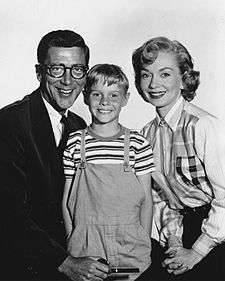
Dennis the Menace entertained us with his inept efforts to be helpful, and his generous heart taught children like me to love our neighbors. His parents were often at a loss as to how to handle what Dennis might get into next, but they always explained to their son how he might have done things differently with less disastrous results.

Even westerns taught Judeo Christian morality. In The Rifleman, a father taught his son right and wrong and to use violence as a last resort to save other lives. The Lone Ranger never looked for credit for his good deeds. The rescued asked, “Who was that masked man?” as he rode into the sunset. Lessons in humility.

I want the same lessons of goodness in the books I read where characters solve problems in an honorable manner. It’s why I prefer the classics, books that contain intact families who love each other and face conflicts together. I get so tired of the dysfunctional families and missing parents in today’s literature. As an experiment, I went through the archives of my book reviews and checked the family situations in each of the books I’ve featured. I was dismayed by the results:

Dysfunctional Family/Missing Parent  22; Loving, Intact Family 11.

 Even if I discount the handful of books written past 1990, earlier authors also use the lack of a good parent as an integral part of the conflict for the child protagonist.  I love each one of these stories, but I’m saddened by that reality.


Summer of the Swans by Betsy Byars is a case in point. Thirteen-year-old Sara lives with her snarky teenage sister, her little brother Charlie, and their aunt. Their mother died; their dad split. Charlie has unnamed developmental disabilities. Today we might say he’s on the autism spectrum. Sara loves Charlie; she hates his neediness. She hates herself as many young adolescents do. The novel is beautiful and character-driven with a flawed protagonist who finally realizes she loves her brother as he is.

Most of the events in the plot could have been accomplished with a mom and dad still around. Two parents could have struggled together in dealing with Charlie’s eccentricities, and teens in their struggle for independence get in grand funks even when they grow up in wonderful, loving homes.

Strong families are not exempt from ongoing crises. I’m currently writing a fictionalized memoir covering the first five years of my little sister’s life. Our parents enjoyed a solid marriage, and they had to cope with the uncertainties of raising a profoundly deaf child. Heartbreaking events occurred, and comical episodes still made life fun. We were strong. We were together.

This is what I feel called to do in my writing, to glorify God with stories of family who strive together to overcome the obstacles in their path as they journey through life, pilgrims on the way to the Promised Land.


www.lindasammaritan.com

Linda Sammaritan writes realistic fiction, mostly for kids ages ten to fourteen. She is currently working on a middle grade trilogy, World Without Sound, based on her own experiences growing up with a deaf sister.
Linda had always figured she’d teach middle-graders until school authorities presented her with a retirement wheelchair at the overripe age of eighty-five. However, God changed those plans when He gave her a growing passion for writing fiction. In May of 2016, she blew goodbye kisses to her students and dedicated her work hours to learning the craft. She still visits the school and teaches creative writing workshops.


Where Linda can be found on the web: