"Hoosier Ink" Blog

Wednesday, December 4, 2013

Year End Mourning and Joy


     The holidays—Thanksgiving, Christmas, New Year’s Eve—follow closely upon each other sending us in a rush, making our heads spin. For many of us these days are accompanied by dreary gray with the sun on a short schedule. Too-long evenings stretch interminably, sapping energy, spontaneity, and creativity. This whole mix adds to regrets of another year passed with plans incomplete. It may even occur to us that opportunities have been wasted. We fear our most cherished hopes – perhaps for publication are once again dashed.

     In “Journey to Christmas” my chapbook of poetry of the thoughts and feelings of those involved in the first Christmas, Joseph is in this same predicament. He had spent hours, days, weeks, maybe even months preparing a home for his cherished hope - Mary. The news of her pregnancy, of which he had no part, was bitter. It seemed all was lost. All his work and preparation was a mockery. He was ready to cast it all away, forgetting that God has his own way of doing things that often sends us over the rough road, tests our inner strength, reveals our true motivations, and uncovers our weaknesses.

     If you are experiencing year-end blues, think of Joseph and how what he thought to be true was exactly the opposite of how things turned out. Within months, he found himself to be happily married and raising the Messiah. It was an unexpected culmination of many of his heart’s desires. As you compare your 2012 to Joseph’s feelings, take heart. It’s not over until God says it’s over. He’s doing a great thing in you, in his own time.

Mourning His Loss

Grief over what we’ve lost is natural even if what we’re losing has not been ours except in our dreams.
I’ve worked upon this house
Muscles straining timbers,
slapping mortar into place,
making it respectable.
Now, lamplight flickers on white walls
in a room we’ll never share
as husband and wife,
pure, sweet, Mary and I.
Pure?
Sweet?
I cannot believe it’s true.
Was it her naïveté
or her gentle kindness
That did her in?
I only know we’re through.

This place will make someone else
A good home.
Someone who will care for it,
not tear it—and us— down,
throw away everything
for a youthful fling.
Mary. Mary. How could you?
You were like sweet honey and sunshine.
Who snuffed the light that once was you
cheering the darkness?
The dark and silent night
mocks me and each decision
I could make.
Still…
for all she’s done,
who am I to throw the first stone?
Am I so perfect? No.
But, I can’t marry her either.
I will divorce her quietly.
It is settled.
How it wearies me.
Oh, that I would never wake
to the uneasy task tomorrow brings.


Merry Christmas, ACFW friends. May Jesus live so large in your hearts that others see Him when the look at you, recognize Him when they read your writing, and be drawn to Him by the love within you.

Mary Allen is a Hoosier author and poet. She was the La Porte County Poet Laureate 2010. 


To order your e-book copy of "Journey to Christmas" go to  http://www.amazon.com/dp/B00APSB0DS/ref=cm_sw_r_fa_dp_IKMNsb17H5GMH

Sunday, December 1, 2013

SANTA CLAUS, INDIANA: CHRISTMAS TOWN USA by Ramona Cecil


I love Indiana history, so, as a Hoosier author, I’m always on the lookout for an interesting Indiana story setting. As we enter the season of the celebration of our Savior’s birth, it occurred to me that a little town on Indiana’s southern border could make the perfect setting for a Christmas themed story.


The town of Santa Claus, Indiana is situated in Spencer County along the Ohio River. With a population of under three thousand, Santa Claus would likely be but another sleepy little river town if not for its unusual name. How that name came to be, however, is so tangled in legend that the truth may be hard to untwine, lending a mythical aura to the town, which somehow seems altogether appropriate.


What we do know is that the community was platted in 1849 and originally given the name Santa Fe. It kept that name until the mid 1850’s when the town applied for a post office. The US Post Office Department denied the town's request informing them that the name Santa Fe was already taken, so if they wanted a post office they'd need to change the town’s name.


Okay, here’s were the historical facts get a little foggy. Where’s Rudolph when you need him? According to legend, on Christmas Eve, as the townspeople concluded services at the little log church, they convened their final town meeting for the year. The single order of business was to select a new name for the town, but they were having trouble coming to a consensus of what the new name should be. As the story goes, a sudden gust of wind blew open the church door and the sound of distant sleigh bells were heard. The children began to excitedly exclaim “Santa Claus! It’s Santa Claus!” The adults, probably tired and eager to head home for a warm supper and bed, grasped onto the name. The scriptures tell us that “A little child shall lead them,” so who is to say the inspiration for the town’s new name wasn’t heaven-sent? In any event, I love the story and I’d like to believe it’s true. My imagination goes wild. . .


Back to fact. On May 1st of 1856, the U.S. Post Office Department approved a post office for the town of Santa Claus, Indiana. In 1895, the name was changed to one word; Santaclaus and the place faded into obscurity until 1914 when the town’s post master, James Martin, began promoting the town’s festive postmark on Christmas cards. He even began answering children’s letters to Santa; a practice that is still carried on by volunteers today.


In 1929, a growing volume of holiday mail began flowing into the tiny post office to get the official “Santa Claus” postmark. This caught the attention of Ripley’s Believe It or Not and the town of Santa Claus, Indiana was featured in their newspaper cartoon. Thrust into the national spotlight, the little post office was deluged with over a million pieces of mail.


Santa's Candy Castle
In 1932 Santa Claus, Indiana came to the attention of a man named Milton Harris. The idea of the place sparked Harris’ imagination, and he dreamed of developing a themed attraction called “Santa Claus Town in the little southern Indiana berg. There Santa would work year round and it would be Christmas morning every day. With the dedication of Santa’s Candy Castle, Harris, with postmaster Miller, launched Santa Claus Town—America’s first theme park—December 22nd 1935. The attraction included Santa’s workshop complete with the jolly old guy himself and his elves, and a Toy Village where children could play with popular American made toys; something out of reach for many tykes during the Depression years.


A second attraction, Santa Claus Park, was crowned by a twenty-two foot tall cement statue of Santa which stood atop the highest hill in town. I remember seeing that statue when I visited the place as a child after it became Santa Claus Land, owned and operated by Louis Koch and his son, William. What fun to see Santa in the middle of the summer!  

Later renamed Holiday World, the amusement park at Santa Claus, Indiana has grown and grown and is now a fond childhood memory for my two own daughters.


Despite the widely held belief that Santa Claus lives at the North Pole, we Hoosiers know better. The jolly old elf really resides right here in good ole Indiana, and we have the postmark to prove it!

As for my Santa Claus, Indiana story. . .I don't have it yet, but it's percolating.

Thursday, November 28, 2013

The Case of the Crusade Wars

Plagiarism is illegal, right?

Wrong. Most people would agree that it is unethical, and it can ruin a writer’s career. But it is not illegal.

In 1949, Twentieth Century Fox produced a television series called “Crusade in Europe.” The series was based on a World War II book by then General Dwight D. Eisenhower. The copyright for the series expired in 1977, and it entered the public domain.

In 1988, Dastar Corp. produced and sold a series of video tapes that borrowed heavily from the earlier television series. Since the series was in the public domain, Dastar had every right to use that material. But Dastar did not credit the original series, which made its use plagiarism.

There was no law prohibiting plagiarism, and Twentieth Century Fox knew that it didn’t have a case under the copyright laws. So it tried a different tact.

Twentieth Century Fox argued that Dastar’s unattributed use violated the trademark laws. Those laws prohibit “reverse passing off,” which is the practice of putting your own label on someone else’s goods. Twentieth Century Fox argued, in essence, that by using footage from the series without attribution, Dastar led consumers to believe that it had produced the material.

The theory sounds good on its face, but consider this.

Copyrights last for a limited duration. And although people argue over whether the length is too long or too short, it is still limited. (For most works created after 1978, the term is life of the author plus 70 years. In 1949, the term was 28 years unless renewed, which Twentieth Century Fox failed to do.)
 
Trademarks last as long as you use them, which could be forever. Because of this difference, Twentieth Century Fox’s reading of the trademark laws would make them conflict with the copyright laws, and courts don’t like that, especially since the framework for the copyright laws is included in the U.S. Constitution.

So what did the Supreme Court say? “[O]nce the . . . copyright monopoly has expired, the public may use the . . . work at will and without attribution.” (Pgs. 33-34.)

Plagiarism is not illegal, so Dastar won the case.

Still, that doesn’t make it right, nor does it make it prudent. It's never a good idea to pass someone else's words off as you own. Writers can lose their jobs and their reputations that way.

It’s easy to avoid plagiarizing: simply give the author credit. Or if you don’t know who wrote it, attribute it to “author unknown.”

Join me next month for the final post in this series: The Case of the Obstinate Movie Star. And anyone from my generation will recognize the name.

* * * * *

Kathryn Page Camp is a licensed attorney and full-time writer. Her new book, Writers in Wonderland: Keeping Your Words Legal (KP/PK Publishing 2013) is available from Amazon.com and other retailers. Kathryn is also the author of In God We Trust: How the Supreme Court’s First Amendment Decisions Affect Organized Religion (FaithWalk Publishing 2006) and numerous articles. You can learn more about Kathryn at www.kathrynpagecamp.com.


Friday, November 22, 2013

Interview with Adam and Andrea Graham

by Jeff Reynolds


I frequently attribute my role models as being Dopey, Goofy, Eeyore, and the Cookie Monster. But I keep forgetting one -- the Riddler. My first crush was the Cat Woman (partially because I always liked cats). In other words, the TV series that impacted my life forever was Batman.

Okay, when I became a teen-ager, I started reading other comics, with my favorites being Iron Man, Hawkeye, Mr. Miracle, the Beast (from the X-Men) and the Black Panther, with the Rhino, Kraven, Two Face and the Cavalier joining the Riddler on the bad guys list.

But is there a Christian novel that fits the fun, spoofish views of superheroes the '60's series was? The answer is yes. I'd like to interview Adam and Andrea, the creators of the Powerhouse series. Okay, I'll give a little more to Adam the writer, but Andrea joins in with a couple of questions as well.

I had the honor of reading Powerhouse Hard Pressed this year. I found it to be a very fun and enjoyable read. In that installment (the third in the series), Powerhouse gets to face The Boomerang Bloke, Silver Medal, and Mr. Manners.


Jeff:  Welcome to Hoosier Ink. Let's start with how you to got involved in the loves of your life: Each other, Christ, and writing.

Adam: 
I grew up deeply immersed in Bible and came to Christ when I was seven. However, growing into a relationship with Christ and understanding how to live that out is a lifelong process. I met my wife on the Internet. We fell in love over writing. I flew out to Columbus, Ohio to meet her. We got engaged my seventh day out there and were married in 2002 and have been together 11 years now.

 
 Jeff:  Could you tell us about your Powerhouse series? (Let's see -- what are the odds of you saying no?) How long does it take to recover from having your tongue surgically removed from your cheek afterward? What was the influence for your novel?
 

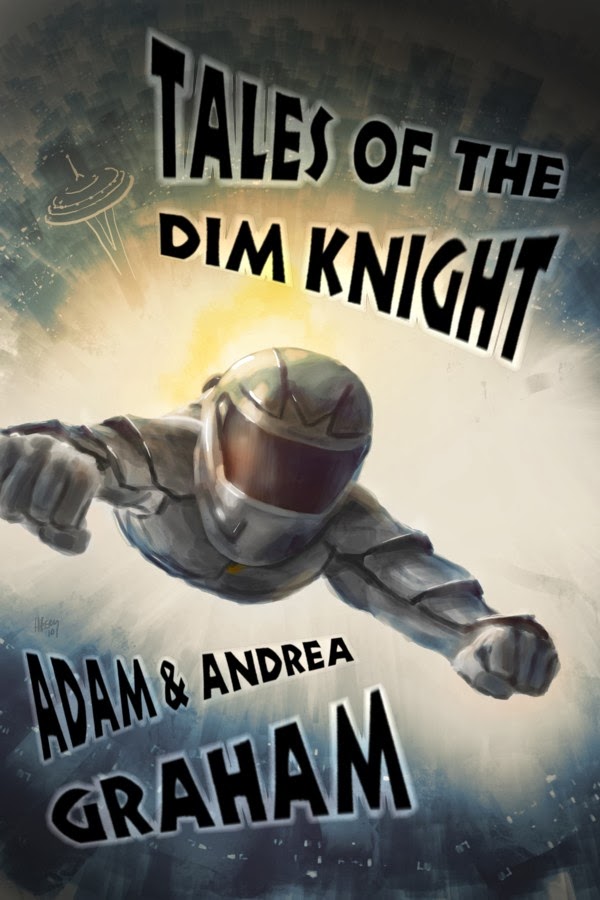
Adam: Tales of the Dim Knight was the first book. It began in 2006 when I saw the DVD of The Tick v. Season One which was a great superhero parody, and I thought that I could do a story like that but with some Christian themes worked in. I also have to give credit to another cartoon from the 1990s Darkwing Duck for planting the idea of a superhero with a family in my head.

So I set down to write a book where I parodied every possible superhero trope I could. My character was Dave Johnson, a huge superhero fanatic and a janitor who works at a facility inspired by the warehouse at the end of "Raiders of the Lost Ark." Dave opens a crate and finds an alien symbiote who turns him into Powerhouse. However, the whole situation causes a big strain on his marriage as he tries to keep secret identity from his wife. She fears he’s losing weight and gaining muscle to impress a mistress.

I wrote the sequels for three reasons: First, I hadn’t covered every superhero trope in the first book. Second, Dave converts to Christianity at the end of Tales of the Dim Knight, and I loved the idea of exploring how you live out the Christian life as a superhero. Third, I came up with a new threat for Powerhouse to fight: the ever-growing corrosive cynicism that’s so dominating society. In the Adventures of Powerhouse, cyncism is symbolically represented by villains who are pushing it so that people will be less likely to resist an alien invasion.

Jeff: Do you have any favorite superheroes and supervillains?

Adam:
In terms of favorite superhero, it’s a tie between Superman and Spider-man, though I don’t like everything writers have done with those characters. In terms of supervillains, it’s got to be Doctor Doom. He’s extremely intelligent and also ruthless and audacious. Everyone in the entire Marvel universe has to gotten to battle him.


Jeff:  Your latest release seems to be a change of pace, at least in genre. I'd like to hear about it. What did you different in writing this one?

Adam:
I host "The Great Detectives of Old Time Radio" podcast and I’ve always been a fan of detective fiction, so I’ve wanted try my hand at it. My short story “An Ounce of Prevention” combines detective fiction and science fiction with a time travel angle. That story was inspired by child abuse cases where police can only pick up the pieces and the thought of, “What if you knew someone was going to do something horrific to a child before they did? How would you deal with that?” It’s a tough question. I don’t know if my hero comes up with the right answer, but I think it’s a thought-provoking question.

Jeff:  You also have a book titled, All I Needed to Know I Learned From Columbo. My assumption is that this is more non-fiction, or at least an analysis of fiction. And please tell me that one of the detectives you looked at is my hero, Poirot.

Adam: AlI I Needed to Know I Learned from Columbo is a short nonfiction e-book that takes a look at life lessons from great fictional detectives. Each chapter begins with an examination of the detective’s history and then we take a look at a life lesson (or five) that can be garnered from it. Among those included are Sherlock Holmes, Nero Wolfe, Father Brown, and Adrian Monk.

Unfortunately, Poirot didn’t make the cut. Poirot is a great detective so he deserves it. However, my acquaintance with him was quite limited back when I wrote this, so I hadn’t yet seen any great life lessons to be drawn from his work. To make up for it, he will get the first chapter in the new book All I Needed to Know I Learned from Dragnet, which will also include chapters on Yours Truly Johnny Dollar, Adam-12, and Cannon.

Jeff:  Time to let Andrea get some thoughts in. Is there a difference in editing your husband and somebody else?

Andrea:
  Yes, it is different to work with my husband. He trusts me more, so it’s easier to give in to the temptation to rewrite for him, since I’m far more likely to get away with it. On the flipside, it’s harder for us to be objective with each other when we do disagree.

Jeff:  I believe marketing your book is a bit similar to, perhaps, running for elected office. Have you noticed any similarities and differences? Any lessons from one that apply to the other?

Adam:
  One lesson I garnered from politics that is relevant to book marketing is that it’s all about finding your audience. I knocked on more than 2000 doors when I ran for office. However, I thought every part of the district and every house deserved to be heard and to have a chance to speak. It was high-minded and noble—and stupid in retrospect. I was running in a primary and needed to reach voters who would be likely to vote in that primary. I ended up losing even though less than 1500 people voted in the primary.

Marketing books also requires targeting. In many ways, it’s more challenging. I could have gotten a list of people who voted in the last primary but finding people who read the books you’re writing can be more challenging, particularly when publishing genres that are a little less popular.

Jeff:  My first contact with you, Adam, is when you pointed out you were recieving several negative reviews on your Audible version of Tales of A Dim Knight. What was the major complaint? Any advice on writing in the current environment/culture we live in? And where do you go to for encouragement?

Adam:
With Tales of the Dim Knight, most of the complaints were that the book had Christian themes. Most of the reviewers of the audiobook version were of the mindset that believes Christian work should be required to carry a warning label.

Christian authors respond in various ways. Some seek to graciously oblige by labeling their work as “Christian” on the cover and in their promotional materials. Others seek to write books where the Christian themes are buried very deep. I don’t seek to hide it when my books have Christian content. The blurb for Fly Another Day mentions that my hero is a new Christian. However,  I don’t go out of the way to warn readers. I read books all the time where I find myself exposed to ideas with which I vehemently disagree and the books didn’t have such a warning label. If you’re going to read widely at all, you’re going to read things that you disagree with.

Readers of science fiction do not have a general objection to religion in fiction. If in Tales of the Dim Knight, Powerhouse were to meet with a pagan goddess and swear loyalty to her, or if he went to a Shaman who gave him a spirit guide who taught him wisdom, this would have been fine. You can find pagan religion in all sorts of fantasy and science fiction stories The same thing goes for denying the existence of God. It’s only Christianity that produces the red flags.

Until I start reading books that have, “Warning: New Age Content” or “Warning: Atheist Content,” Christians complying with these sort of requests will only end up ghettoizing Christian fiction even more. And I turn to fellow Christian writers for support and help because we definitely have to hang together or we’ll hang separately as the saying goes.

Jeff:  What's next? A follow up to “An Ounce of Prevention”? More Powerhouse? Or are you going to try your hand at historical romance?

Adam: 
Lord willing, I’m hoping to release the next Powerhouse book Ultimate Midlife Crisis by June of 2014 and get the second to last book in the Powerhouse series, Speed Trap out before the end of 2014.

In addition, I’ve written a political thriller/detective novel, Slime Incorporated, which Andrea’s editing right now. It’s a great mix of modern and classic detective elements and I hope to have it out early next year. The lead character is Cole Ustick, a secondary character in “An Ounce of Prevention” who also made a cameo in Powerhouse Hard Pressed. 

Finally, I hope to have All I Needed to Know I Learned from Dragnet out next year probably in the Spring or early Summer.

Jeff:  Thank you for your time. Can you refer us to how we can keep in touch with what's new with you all?

Adam: 
You can visit my blog, Christians and Superheroes at http://www.christiansuperheroes.com. Notes on the mystery novel and my old time radio podcast are available at http://www.greatdetectives.net .

 Andrea: You can visit my editing website at http://www.povbootcamp.com

Thursday, November 21, 2013

Life Stinks...And Then You Die {Book Review}

You were pulled in by the title, weren’t you? J

Me too.

Except it’s not my title. It’s the title of a book I just finished by Bob Hostetler about the book of Ecclesiastes.


I particularly wanted to read this book because I tend to have a depressive spirit. {But who doesn't when one looks around at all that is wrong in the world?} Ecclesiastes appeals to me because of that. Misery loves company, and I've wondered if King Solomon and I could have been best buds. But a much more careful reading than I've ever conducted reveals a silver lining to Solomon's cloud of despair. It’s a silver lining I think we all could use when everything seems meaningless.

Bob writes, “This life can knock you down like a Whack-a-Mole and kick you around like a bull does a rodeo clown (you can file that under ‘Great Theological Truths’). Ecclesiastes never paints life any other way. It is gritty and straightforward. But it also shows us conclusively that God loves the hard questions, and he doesn’t insist on pat answers.” (p. 59)

You can see that Bob’s style is witty and conversational. It wasn’t difficult to imagine that Bob and I sat down over a cup of coffee and had a long chat, sharing our miseries in life but infusing the conversation with hope and wisdom. Bob and I also, I imagined, prayed together. Each chapter ends with a prayer, and it’s great to pray it right then, aloud, to ask the Lord to help you apply wisdom to your life.

I feel like I read it too quickly for the purpose of getting this review to y'all. Bob quotes Ecclesiastes extensively, but I want to highlight and make notes in the margin of my Bible. In the near future, I think I'll go back and reread, more slowly, taking time to contemplate and pray and apply the truths. How can we, in our everyday lives, be less concerned with acceptance and approval and more concerned with worship? What do we need to do to let go of the pursuit of wealth and cultivate contentment? When are we going to realize we ought to pray for wisdom above all?

So what is the one essential in all of life? What really and truly matters? If you've read Ecclesiastes, you know the answer. But I like the way Bob says it as well. And now you'll just have to read his book.
J


I was given a copy of this book by Bob Hostetler – himself! – in exchange for a fair and honest review. All opinions are my own.


Meghan Carver is a 2013 ACFW Genesis semi-finalist and the author of several articles and short stories. After achieving a Juris Doctorate from Indiana University and Bachelor of Arts in English Literature from Millikin University and completing a brief stint in immigration law, Meghan heard God calling her to be at home. Now homeschooling her six children with her college professor husband, Meghan has returned to her first love of writing. She blogs about homeschooling and homemaking at www.MeghanCarver.blogspot.com.