"Hoosier Ink" Blog

Thursday, October 27, 2016

Writing Outside Your Culture: Naming Characters, Part II


As mentioned in previous posts, the main character in Creating Esther is an Ojibwe girl who goes to an Indian boarding school in 1895. The practice was to “civilize” the students by giving each of them a traditionally white name. So I had to find two names for my protagonist—an Ojibwe name and a “white” one.

One way that superintendents and teachers chose white names was to compile a list from the Bible and assign the next one. Running through some Biblical names in my head, I settled on “Esther” because it just sounded right. But there was another reason, as well. By the end of the book, my protagonist has made some decisions that put her on the path to saving her people, which is what the original Esther did. My Esther will do it less dramatically and as one of many forces, but the concept works.

Coming up with an Ojibwe name was more challenging. I started by going to one of those baby naming websites and looking for Ojibwe girls’ names. I liked “Keezheekoni” because it supposedly means “burning fire,” and my protagonist has a fiery temperament. Unfortunately, based on the sources I found, it appears to be hard to pronounce.

There was an even bigger problem. While most of the baby name sources list it as a Chippewa name, a couple list it as Cheyenne. Worse, I couldn’t find any of its roots in either A Dictionary of the Ojibway Language by Frederic Baraga or A Concise Dictionary of Minnesota Ojibwe by John D. Nichols and Earl Nyholm. So even though I liked the look and the purported meaning of “Keezheekoni,” I ended up rejecting it.

But the meaning worked well for my story, so I checked both dictionaries for the Ojibwe word for “fire.” Father Baraga’s dictionary listed “ishkote,” while the more modern one used “ishkode.” One letter different, but which is correct?

They probably both are. Ojibwe was originally a spoken language with no written equivalent, and the people who tried to write it down used various spellings. In Red World and White: Memories of a Chippewa Boyhood, author John Rogers says that his new baby brother was named Ahmeek, meaning beaver. But the Concise Dictionary spells beaver a-m-i-k.

In the end, I decided to go with the more modern spelling and name my protagonist Ishkode.

It wasn’t an easy choice, but names matter.

__________

Kathryn Page Camp is a licensed attorney and full-time writer. Writers in Wonderland: Keeping Your Words Legal was a Kirkus’ Indie Books of the Month Selection for April 2014. The second edition of Kathryn’s first book, In God We Trust: How the Supreme Court’s First Amendment Decisions Affect Organized Religion, was released on September 30, 2015. Desert Jewels is searching for a home, and Creating Esther has just begun circulating to publishers. You can learn more about Kathryn at www.kathrynpagecamp.com.

Wednesday, October 19, 2016

Grammar for College Writing


By Kelly Bridgewater

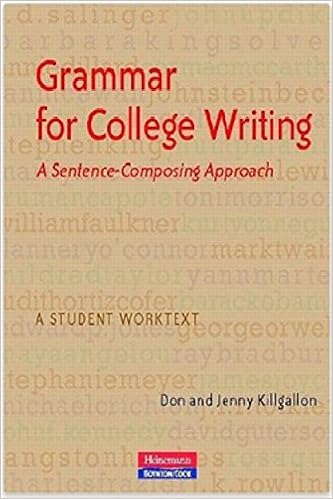
As writers, we are always looking for advice to make our writing jump off the page and into the reader’s imagination. The writing book I’m want to talk about this month is not a writing instruction or advice book where you will find information about plot twists, characters, or how to revise your book. I came across this in grad school when I wanted to figure out how to pump up my writing and make it more sophisticated. Grammar for College Writing by Don and Jenny Killgallon is a great resource for anyone who wants to improve their sentence writing ability. 

From Amazon


How could a book that quotes J. K. Rowling, author of the famous Harry Potter series, who is a master at creating details with her sentences be bad? I knew that I loved the Harry Potter series, but I never actually focused on how she constructed her sentences. After doing the first section in Killgallon’s book, Noun Group: The Naming Tools, I was hooked.

They take simple grammatical words like appositives, gerunds, infinitive, and noun clauses and shows how to expand the sentences using these grammatical devices. She starts each section defining what each term means with at least three different examples from classic literature. Then the review section is usually pretty big. First, you will exchange sentences by switching up the infinitive or gerund with something closely grammatically related. Then you will practice expanding by adding an infinitive phrase or gerund phrase to the bold face section. There is matching. Multiple choices. More practice.

It really helped me to improve my sentences. While I was teaching college at Indiana State University in their English department, I would throw in some grammar on Fridays. Some of the exercises were from this book. I would start the exercise with taking apart one of Rowling’s well-written sentences and make it flow as a simple sentence: He ran. Sweat poured. Foot hurt. After putting the sentence back together, they learned how much better a variety of sentences in our writing can flow better. As much as I enjoyed improving my sentences, I believed my students didn’t like it, but I showed them how richer than writer can be by using these simple tricks.

This is a great book if you want to learn how to make your sentences have more variety. I also suggest looking at J. K. Rowlings famous series and observe how her sentences just flow off the page.

Do you enjoy learning how to grammatically better your sentences better? As a writer, grammar should be important to our lives as much as the creating of our stories.

Sunday, October 9, 2016

Come hear Laura Frantz speak in November!

I'm so excited about our upcoming ACFW-Indiana event! I hope you'll RSVP and join us!

Check out this video of how one of her book covers was made. LOVE it!


Can't wait to see you there!

Thursday, September 22, 2016

Writing Outside Your Culture: Researching Location, Part II

 
In an earlier post, I wrote about travelling to the place where Desert Jewels took place. I did the same with Creating Esther. I dragged Roland along as I travelled throughout Ojibwe country in Michigan, Wisconsin, and Minnesota to visit museums and reservations and the shells of former Indian boarding schools.

I already knew, of course, that different tribes had different customs and ways of life. But I didn’t know that a few hundred miles could make a difference within a tribe.

The main elements of Ojibwe life and history were the same at each location. Every exhibit we saw referred to the Ojibwes’ seasonal way of life: collecting maple syrup in the spring, fishing and berrying and planting gardens in the summer, harvesting wild rice in the fall, and hunting in the winter. (Actually, fishing and hunting took place all year long, but they were more predominant at those times.) Families moved from one place to another for these seasonal activities but tended to return to the same spot every spring, every summer, every fall, and every winter. In all regions, the members of the tribe also had the same clan system (although not always the same clans) and the same teachings passed down through their oral history.

But they didn’t all live in the same type of birch-bark housing.

Before we left, I thought all of the earlier Ojibwe lived in birch-bark wigwams with the rounded shape shown in the museum exhibit above. On the research trip, I learned that the construction materials varied somewhat depending on the season. Woven birch-bark mats covered the frame in the hot summer months, which allowed the wall coverings to be raised so that air could circulate through the lower part of the frame. In the winter, the walls were insulated with moss and the floors used a radiant heating system.

All of that was helpful new information, and none of it surprised me.

What did surprise me was that the Minnesota Ojibwe used a birch-bark teepee during the winter. We saw no evidence of this in Michigan or Wisconsin, where winter dwellings were built using the wigwam shape. A guide at the Mille Lacs Indian Museum told us that the teepee shape keeps the dwelling warmer. (Since heat rises, the smaller air space near the ceiling would keep more of the heat down by the floor.) During the warmer months, there were no regional differences—all dwellings were built as wigwams. But the winter shape seems to have been modified as members of the tribe moved farther west and closer to the plains Indians, who lived in animal skin teepees.


It isn’t always possible to take research trips to the sites in our fiction, but it has always been worthwhile for me when I had the opportunity. And this one kept me from falling into the pitfalls created by regional differences.
Because honoring regional differences is part of honoring the culture.
__________
I took the first picture at the Ziibiwing Center of Anishinabek Culture and Lifeways at Mount Pleasant, Michigan, and the second at Grand Portage National Monument in Grand Portage, Minnesota.
__________
Kathryn Page Camp is a licensed attorney and full-time writer. Writers in Wonderland: Keeping Your Words Legal was a Kirkus’ Indie Books of the Month Selection for April 2014. The second edition of Kathryn’s first book, In God We Trust: How the Supreme Court’s First Amendment Decisions Affect Organized Religion, was released on September 30, 2015. Desert Jewels is searching for a home, and Creating Esther has just begun circulating to publishers. You can learn more about Kathryn at www.kathrynpagecamp.com.
Wednesday, September 21, 2016

Writing for the Soul


By Kelly Bridgewater

I saw Jerry B. Jenkins writing book advertised in the back of one of my fiction books, and I couldn’t wait to get my hand on the book. I have loved all of Jerry B. Jenkins Left Behind books and always wanted to take The Christian Writer’s Guild courses, but financially, I couldn’t afford it. 

From Amazon


Writing for the Soul is a quick read that you could sit down and read straight through for a couple of hours. It really doesn’t throw anything at you that would require you to do exercises upon exercises. It grips your attention and comforts you. At the end of each chapter, there is a Q and A section where Jenkins answers questions.

The story reminds me of On Writing by Stephen King. It is part autobiographical plus part helpful hints. Jenkins allowed me to learn how he became a writer and moved up the ranks from writing tons of articles to publishing short stories to become a published writer of many books. He wanted to give back to the writing community because so much had been given to him. As the back cover states, “Jenkins shares the honest and straightforward truth about how to find writing success and why the journey is a continuous one.”

As I’m sure a lot of you here are like me, we have wanted to write for a while now and are always on the lookout for things to inspire and encourage us on this lonely road. We, including me, need encouragement from time to time. This journey can be tough and bumpy. Jenkins offers just that. Encouragement. Comfort. Tossed in a few tips with honest answers. Now you have Writing for the Soul. I pick up this book when I need a pick me up about my writing choice.

What book do you return to, besides the Bible, for encouragement about writing? Are there moments where you just want to quite? I have those about once a week, so you’re not alone.