"Hoosier Ink" Blog

Showing posts with label First Amendment. Show all posts

Thursday, December 25, 2014

A Writer's Guide to the First Amendment: Proceed with Caution


If you’ve been following my 2014 posts, you know that the First Amendment is not a “get out of jail free” card. It’s a priceless freedom, and I’m grateful for it. But if you don’t understand its limits, you could find yourself liable for damages and attorneys’ fees.

Contrary to what some people believe, the First Amendment does not allow you to say (or write) whatever you want. Its protections are designed to promote open discussion, but it does not authorize anarchy.

As a writer, the First Amendment can work for you or against you. It can work for you if you want to engage in a robust public debate without having to check and double-check every fact for accuracy. It can work against you if you expect it to protect you from statements you don’t believe yourself. (See my June 26, 2014 and July 24, 2014 posts.)

It can work for you if you bring your arguments into a public forum at a reasonable time and place and in a reasonable manner. It can work against you if you take those arguments onto private property or act in a way that disturbs the peace. (See my March 27, 2014 post.)

It can work for you if you honor the copyright and trademark laws. It can work against you if you ignore those laws.

Yes, the First Amendment protects most speech. But it doesn’t protect everything.*

So how can you ensure that it works for you? While there are no guarantees, here are my best suggestions:

  • Do your homework. If you still have doubts about the truthfulness of the information, turn off the computer and put down the pen.
  • Make your arguments in a public place or to a willing audience. Don’t force anyone to listen.
  • Learn how copyrights and trademarks work, and don’t infringe on the owners’ rights. (Watch for future posts on these issues.)

__________

*There are several other types of unprotected speech that Christians are unlikely to engage in. See my April 24, 2014 post for more information.

__________

Kathryn Page Camp is a licensed attorney and full-time writer. Her most recent book, Writers in Wonderland: Keeping Your Words Legal (KP/PK Publishing 2013), is a Kirkus’ Indie Books of the Month Selection. Kathryn is also the author of In God We Trust: How the Supreme Court’s First Amendment Decisions Affect Organized Religion (FaithWalk Publishing 2006) and numerous articles. You can learn more about Kathryn at www.kathrynpagecamp.com.

Thursday, November 27, 2014

A Writer's Guide to the First Amendment: Commercial Speech


I’m already tired of Christmas commercials. Maybe I should petition the government to ban them. Oh, wait. Those regulations would violate the First Amendment freedom of speech. So never mind.

Commercial speech, such as advertisements, gets less protection than non-commercial speech. But less does not mean none. As a general matter, governmental entities cannot regulate commercial speech unless the speech:

  • concerns an illegal activity (e.g., the government can ban advertisements for heroin),
  • is misleading, or
  • the government’s interest in restricting the speech is substantial and the particular regulation directly advances that interest. (This category is so limited that I can’t even come up with a good example.)
Furthermore, the regulation must be narrowly tailored to serve the government’s interest. For example, the government cannot ban advertisements for all drugs when only some are illegal.*

Commercial speech may also receive less protection under statutory and common laws that give private parties the right to sue each other (e.g., lawsuits for libel). Unfortunately, the U.S. Supreme Court has never decided how the commercial speech doctrine applies to private lawsuits and the lower courts don’t always agree with each other.  

But what is commercial speech? Legally, it is any speech that proposes an economic transaction. In lay terms, commercial speech is any speech—verbal, written, or otherwise—that is trying to get you to pay for something the speaker has to offer. This doesn’t necessarily require an explicit solicitation, however. Merely using a trademark on an educational brochure may be enough.

On the other hand, the mere fact that the speaker/writer is in it for the money doesn’t make it commercial speech. Many reporters wouldn’t write news articles if they didn’t get paid, but that doesn’t make the articles commercial speech. And even though you hope your novel will make you a millionaire, it isn’t commercial speech, either.

But that advertisement for your novel and the bookmark or postcard you created to promote it are commercial speech. If you use them to misrepresent the book, you could get into trouble. But no government can pass a regulation prohibiting you from advertising the novel.

So go ahead and join the Christmas rush.

__________

* This test comes from Central Hudson Gas & Electric Corp. v. Public Service Commission, 447 U.S. 557 (1980), as modified by Board of Trustees v. Fox, 492 U.S. 469 (1989).

__________

Kathryn Page Camp is a licensed attorney and full-time writer. Her most recent book, Writers in Wonderland: Keeping Your Words Legal (KP/PK Publishing 2013), is a Kirkus’ Indie Books of the Month Selection. Kathryn is also the author of In God We Trust: How the Supreme Court’s First Amendment Decisions Affect Organized Religion (FaithWalk Publishing 2006) and numerous articles. You can learn more about Kathryn at www.kathrynpagecamp.com.

Thursday, October 23, 2014

A Writer's Guide to the First Amendment: Religious Speech under the Free Exercise Clause


The Establishment Clause, which I discussed in last month's post, protects Americans against having to practice someone else’s religion. The Free Exercise Clause, on the other hand, gives Americans the right to affirmatively practice their own religion.

This is an unconditional protection where beliefs are involved. Religiously-motivated conduct is a different matter. If one person’s religious conduct has no direct effect on others or merely inconveniences them, the government cannot prohibit the religious conduct. If the conduct places someone in jeopardy, that conduct must give way. The Constitution protects the right to own a Bible, but it does not protect human sacrifice. Most people agree with this principal but disagree on where to draw the line between inconvenience and jeopardy.

In most cases, however, religious conduct falls within the “inconvenience” category. If you want to pass out religious pamphlets on the streets, it may not make pedestrians happy. But as long as you take precautions against littering, there isn’t a lot the government can do to stop you.

Let’s move to the school context. A teacher can’t assign an essay on the topic, “why Christianity (or Islam, or Buddhism, or atheism) is the only truth.” That’s forcing those with different beliefs to practice someone else’s religion. But the school also can’t discriminate against students who bring their own beliefs into an assignment as long as the student follows the assignment guidelines. Assume a Kindergarten teacher tells the members of her class to draw a picture of that child’s best friend so the teacher can post the drawings around the room for an open house. If one student decides his best friend is Jesus and draws a picture of a man hanging on a cross, the Free Exercise Clause requires the teacher to post it with the others. If a 9th grade history teacher asks his class to write a 500-word essay about George Washington, free exercise doesn’t give students a pass to write about Jesus instead. But they can write about George Washington’s relationship with Christ.

In 1943 the Supreme Court said public schools cannot lock God out of the classroom,* and in 1962 it said they cannot invite him in.** So what is a school’s job as an attendance monitor? To watch the door when God enters and see if He comes in with a student or a teacher. Because that makes all the difference.

__________

* West Virginia State Board of Education v. Barnette, 319 U.S. 624 (1943), struck down a law that required students to salute the flag. The Jehovah’s Witnesses believed that saluting anything other than God violated the second commandment. By striking down the law, the Supreme Court said, in essence, that students could bring their religious beliefs into the classroom with them.

** Engel v. Vitale, 370 U.S. 421 (1962), is the first case to strike down school-sponsored prayers.

__________

Kathryn Page Camp is a licensed attorney and full-time writer. Her most recent book, Writers in Wonderland: Keeping Your Words Legal (KP/PK Publishing 2013), is a Kirkus’ Indie Books of the Month Selection. Kathryn is also the author of In God We Trust: How the Supreme Court’s First Amendment Decisions Affect Organized Religion (FaithWalk Publishing 2006) and numerous articles. You can learn more about Kathryn at www.kathrynpagecamp.com.

Thursday, September 25, 2014

A Writer's Guide to the First Amendment: Religious Speech under the Establishment Clause


The Establishment Clause of the First Amendment says, “Congress shall make no law respecting an establishment of religion.” As I explained in my February 27, 2014 post, the restriction isn’t limited to Congress but includes state and local governments.

But what does the clause mean? Thousands of books have tried to answer the question, and I don’t have the space in this blog post to add my thoughts. For our purposes, it is enough to say that the Supreme Court’s decisions make it clear that governments cannot endorse or favor any particular religion. They can, however, allow religious speech in a governmental setting as long as all religions (and atheism) are treated equally. The cases also make it clear that context matters.

This is the main distinction between the various cases involving Christmas displays. In County of Allegheny v. ACLU, 492 U.S. 573 (1989), the Supreme Court even reached opposite conclusions in the same case. There were, however, two separate displays, and the distinctions directed the results. These pictures were printed with the Supreme Court opinion, and they are not good quality when reproduced here. Nonetheless, they may help you understand the general impression that each conveyed.


The first display involved a large crèche displayed prominently on the Grand Staircase in the county building. Although it was surrounded by poinsettias and small evergreens, they tended to highlight the crèche rather than distract from it.

The second display was one block away on city land. The centerpiece was a large Christmas tree flanked by a menorah on one side and a sign on the other that identified the display as a “Salute to Liberty.”

Four justices voted that both the manager scene and the menorah violated the Establishment Clause, and four justices voted that neither did. Justice Blackman was the swing vote that split the decision.

According to Blackman, the first display violated the Establishment Clause because the crèche is clearly a religious symbol, with the Nativity being a crucial part of the Christian message. For him, the context made it clear that the county was endorsing that message.

He reached a different conclusion for the second display. He dismissed the Christmas tree as a secularized representation of Christmas but had a harder time with the menorah. Even so, he felt that the menorah had taken on some secular implications as well. The combination of these two symbols with the “Salute to Liberty” theme swayed him to vote that the city display was constitutional.

Today the courts seem to agree that even a manger scene is acceptable if it is provided by private individuals or organizations and is part of a larger display. In other words, religious speech is acceptable on government property if it is allowed rather than mandated and if all religions (and atheists) are given equal treatment. This is true in schools as well as in the public square.

Next month we will discuss the government’s ability to restrict your religious speech.

__________

Kathryn Page Camp is a licensed attorney and full-time writer. Her most recent book, Writers in Wonderland: Keeping Your Words Legal (KP/PK Publishing 2013), is a Kirkus’ Indie Books of the Month Selection. Kathryn is also the author of In God We Trust: How the Supreme Court’s First Amendment Decisions Affect Organized Religion (FaithWalk Publishing 2006) and numerous articles. You can learn more about Kathryn at www.kathrynpagecamp.com.

Thursday, August 28, 2014

A Writer's Guide to the First Amendment: A School for Thought?


Because most readers of this blog are writers, some may have been on the staff of their school newspapers. And those who were in high school or college after 1988 may be aware of Hazelwood School District v. Kuhlmeier, 484 U.S. 260 (1988).

In Hazelwood, the school principal pulled two articles from the student newspaper before it went to press. One article talked about the pregnancy experiences of three female students, and, although their names were changed, the principal was concerned that enough details remained to make them identifiable. He was also concerned that some of the discussion in the article was inappropriate for younger students. The second article talked about divorce and included a comment by a named student disparaging her father, who had not been given the opportunity to respond. Since the school year was nearing its close, the principal didn’t believe there was time to remedy the problems with either article. As a result, he simply pulled them.

The Supreme Court ruled that the principal did not violate the student journalists’ First Amendment rights. The newspaper was funded by the school and operated as part of the school’s educational activities. The Court held that “educators do not offend the First Amendment by exercising editorial control over the style and content of student speech in school-sponsored expressive activities so long as their actions are reasonably related to legitimate pedagogical concerns.” And most of us would agree that journalistic integrity is a legitimate pedagogical concern.

The test is different when dealing with individual student speech that happens to occur on school premises or at school activities. Students do not “shed their constitutional rights to freedom of speech or expression at the schoolhouse gate.” Tinker v. Des Moines School District, 393 U.S. 503 (1969). Nonetheless, a school is a special setting, and administrators can prohibit some behavior that would be covered by the First Amendment in a different context. In particular, the administration can discipline behavior that materially disrupts learning, interferes with the rights of other students, uses lewd or offensive language, or advocates criminal behavior.

Tinker shows one end of the spectrum—the one where the First Amendment trumps school action. In that case, the school warned and then suspended five students who wore black armbands to protest the Vietnam War. Although the armbands made some students uncomfortable, they did not interfere with schoolwork, disrupt classes, or produce any violence. The Supreme Court held that the administration’s actions violated the students’ First Amendment rights.

There are cases on the other end of the spectrum as well. In Bethel School District v. Fraser, 478 U.S. 675 (1986), the Court held that a school could discipline a student who used sexual innuendos during a school assembly. And in Morse v. Frederick, 551 U.S. 393 (2007), the Court upheld an action suspending a student for displaying a banner that could have been interpreted as advocating illegal drug use. What Morse added to Bethel was the context. Fraser made his comments on school grounds, while Frederick’s conduct occurred during a school outing.

The line is fuzzy, but one thing is clear. Students don’t lose all their First Amendment rights when they go to school, but they do lose some.

But you may be thinking, “What about all those cases involving religious activities in the schools. Why didn’t she mention them?”

Since this is a blog for writers, these monthly posts concentrate on the speech clauses of the First Amendment. Most of the school religion cases were decided under the religion clauses.

Still, there are cases in which the speech clauses intersect with the religion clauses. We’ll discuss that topic next month.

__________

Kathryn Page Camp is a licensed attorney and full-time writer. Her most recent book, Writers in Wonderland: Keeping Your Words Legal (KP/PK Publishing 2013), is a Kirkus’ Indie Books of the Month Selection. Kathryn is also the author of In God We Trust: How the Supreme Court’s First Amendment Decisions Affect Organized Religion (FaithWalk Publishing 2006) and numerous articles. You can learn more about Kathryn at www.kathrynpagecamp.com.

Thursday, July 24, 2014

A Writer's Guide to the First Amendment: The Actual Malice Trap


Last month I mentioned that public officials and public figures who sue the press for libel have to prove that the press acted with “actual malice.” That’s the legal term, but it’s a bit of a misnomer. That’s because the U.S. Supreme Court has defined actual malice as “knowledge that [the statement] was false or with reckless disregard for whether it was false or not.” (New York Times Co. v. Sullivan, 376 U.S. 254, 279-280 (1964))

Just as a reminder, I am using the term “press” to include any media that has the potential to reach a large audience. That includes your novel or your blog.

For legal purposes, malice is not synonymous with ill will. You can have the best intentions and even admire the person you write about. But if you know that what you write is false or have serious doubts about its truth, that’s enough for a jury to find that you acted with actual malice.

While we’re at it, let’s apply the actual malice test to that female drug-addict in your novel—the one who shares a lot of characteristics with your sister. But your sister doesn’t use drugs, and you know it. You just thought it made a more compelling story. Unfortunately, the fact that you know it isn’t true turns it into actual malice. And if people who know your sister recognize her, no disclaimer will help. So make sure you mix and match traits or change enough characteristics to disguise your model.

Let’s go back to the reckless disregard part of the test. What if you aren’t sure that your facts are true? Uncertainty isn’t enough to prove reckless disregard—it takes serious doubts. Or what if you thought your facts were correct but your investigation was careless or incomplete? It takes more than carelessness to show actual malice. On the other hand, inaction may be sufficient. If you purposefully avoid the best sources because they may prove you wrong, that could show actual malice. You cannot ignore your obligations by intentionally looking the other way.

So what should you do? Don’t make factual statements about someone in a non-fiction context unless you have reason to believe the statements are true.

And don’t write a novel about your sister.

__________

Kathryn Page Camp is a licensed attorney and full-time writer. Her most recent book, Writers in Wonderland: Keeping Your Words Legal (KP/PK Publishing 2013), is a Kirkus’ Indie Books of the Month Selection. Kathryn is also the author of In God We Trust: How the Supreme Court’s First Amendment Decisions Affect Organized Religion (FaithWalk Publishing 2006) and numerous articles. You can learn more about Kathryn at www.kathrynpagecamp.com.

Thursday, June 26, 2014

A Writer's Guide to the First Amendment: Be Careful Who You Libel


What is freedom of the press and how does it differ from freedom of speech? In one sense, it is merely a subset of freedom of speech. But speech that reaches the masses—or has the potential to—creates additional concerns. On one hand, it can do greater damage. On the other, the potential to reach a larger audience tempts government to take more severe measures to surpress any attempt to use it to speak out against the government. It was this latter concern that caused the founders to create a separate freedom for the press.

At the time, the clause applied to newspapers and pamphlets and books that came from a printing press, because those were the media that could reach large audiences. But if the size of the potential audience is the reason behind the clause, it should expand beyond these traditional media to include television and the Internet, and that is how courts tend to apply it. It can even cover blogs like this one. (See Obsidian Finance Group, LLC v. Cox, (9th Cir., Jan. 17, 2014).)

The U.S. Supreme Court developed the rules for media in a line of cases that began in 1964 with New York Times Co. v. Sullivan, 376 U.S. 254 (1964). In deciding the case, the Supreme Court noted that America is committed to “uninhibited, robust, and wide-open” public debate on public issues. Recognizing that no test is perfect, the Court believed it was better to err by protecting some false speech than by hindering truthful speech. According to the Court, requiring a speaker/writer to guarantee the truth of his statements at the pain of paying large libel judgments would inhibit criticism even when the speaker believed his statements were accurate.

For that reason, the Court held that the First Amendment “prohibits a public official from recovering damages for a defamatory falsehood relating to his official conduct unless he proves that the statement was made with ‘actual malice’.”

The New York Times case was limited to comments about public officials. The Supreme Court later extended the same test to comments about public figures (e.g., the athletic director of the University of Georgia). It’s much harder to get away with libelous statements about private individuals, however.

But even the President of the United States can sue you—and win—if you libel him or her intentionally. You may even be liable for libel if you just don’t care whether you are telling the truth about a public official. That’s because of the exception for actual malice.

So what is actual malice? We’ll talk about that next month.

__________

Kathryn Page Camp is a licensed attorney and full-time writer. Her most recent book, Writers in Wonderland: Keeping Your Words Legal (KP/PK Publishing 2013), is a Kirkus’ Indie Books of the Month Selection. Kathryn is also the author of In God We Trust: How the Supreme Court’s First Amendment Decisions Affect Organized Religion (FaithWalk Publishing 2006) and numerous articles. You can learn more about Kathryn at www.kathrynpagecamp.com.
Thursday, May 22, 2014

A Writer's Guide to the First Amendment: When Actions Speak Louder than Words


As writers, we deal with words. After all, the pen is mightier than the sword, as Edward George Bulwer-Lytton said. So why do we care if the First Amendment applies to actions?

Because words aren’t always enough. Sometimes actions say it more powerfully.

It’s 1984, and you want to protest the policies of the Reagan administration. You could write a letter to your Congresswoman, but will she read it? Or you could write an article, but what if every magazine you submit it to rejects it?

There has to be some way to get the administration’s attention.

Then someone suggests burning the American flag. Unfortunately, the law says that’s a crime.

You do it anyway and get arrested. The case goes all the way to the Supreme Court—and you win! When action is a form of expression, it is protected by the First Amendment. (See Texas v. Johnson, 491 U.S. 397 (1989) and U.S. v. Eichman, 496 U.S. 310 (1990).)

Of course, the government can still regulate the time, place, and manner of the expression. (See my March 27, 2014 post.) But it can’t regulate the expression itself.

The pen may be mightier than the sword, but actions do speak louder than words.

Still, you’re a writer, not a protester. You want to know how the First Amendment applies to the words you put on paper.

Stay tune for next month’s post on freedom of the press.

__________

Kathryn Page Camp is a licensed attorney and full-time writer. Her most recent book, Writers in Wonderland: Keeping Your Words Legal (KP/PK Publishing 2013), is a Kirkus’ Indie Books of the Month Selection. Kathryn is also the author of In God We Trust: How the Supreme Court’s First Amendment Decisions Affect Organized Religion (FaithWalk Publishing 2006) and numerous articles. You can learn more about Kathryn at www.kathrynpagecamp.com.

Thursday, April 24, 2014

A Writer's Guide to the First Amendment: Obscenity, Fighting Words, and Advocating Illegal Conduct


Just how far does the First Amendment go in protecting speech? Quite a ways. But what about obscenity? Or fighting words? Or advocating illegal conduct?
 
Yes, there are some exceptions, but they are are extremely narrow.
 
Take obscenity, for example. Just what makes a book or a movie obscene? The U.S. Supreme Court has a three-part test, and all three parts must be met. The first prong makes the determination of obscenity community-based (meaning that something might be obscene in Birmingham, Alabama but not in Las Vegas, Nevada). The second prong restricts obscenity to hard-core porn. The third requires the work, taken as a whole, to lack serious literary, artistic, political, or scientific value. Since literature and art are in the eye of the beholder, this means that very few things are legally obscene. (See Roth v. U.S., 354 U.S. 476 (1957) and Miller v. California, 413 U.S. 15 (1973).)
 
Then there are fighting words. Words likely to provoke the average person to retaliate in the heat of the moment not protected. However, the other person must be present when the words are uttered and there must be a real possibility of immediate retaliation. Organized marches and protests by hate groups such as the Nazis and the Ku Klux Clan and the Westboro Baptist Church are protected because normal police crowd control procedures are sufficient to prevent retaliation. (See Chaplinsky v. New Hampshire, 315 U.S. 568 (1942) and Cox v. Louisiana, 379 U.S. 536 (1965).)
 
Some speech advocating illegal conduct is not protected, either. But again, the exception is narrow. As the Supreme Court has described it, the speech must create a clear and present danger that will bring about substantial evils. Also, the speech must be intended to and likely to incite or produce imminent lawless action. If you know what that means, then you are smarter than I am. I’m waiting to see how the Supreme Court would handle a case where detailed plans for making a bomb are posted on the Internet. (See Schenck v. U.S., 249 U.S. 47 (1919) and Brandenburg v. Ohio, 395 U.S. 444 (1969).)
 
Libel and commercial speech aren’t always protected, either. I’ll cover them later this year.
 
But next month we’ll talk about burning the flag.
 
__________
Kathryn Page Camp is a licensed attorney and full-time writer. Her most recent book, Writers in Wonderland: Keeping Your Words Legal (KP/PK Publishing 2013), is a Kirkus’ Indie Books of the Month Selection. Kathryn is also the author of In God We Trust: How the Supreme Court’s First Amendment Decisions Affect Organized Religion (FaithWalk Publishing 2006) and numerous articles. You can learn more about Kathryn at www.kathrynpagecamp.com.
 

Thursday, March 27, 2014

A Writer's Guide to the First Amendment: The When, Where, and How of Public Speech


You walk into a public park, climb onto your literal soapbox, and start speaking. Then someone calls the cops, and you get arrested. Have the police violated your First Amendment rights?

It depends.

The government can’t regulate what you say, but it can regulate when, where, and how you say it. The regulations must be viewpoint neutral, meaning the outcome should be the same whether you are opposing abortion or defending it. The regulations must also be tailored to serve a significant public interest, meaning that they should not restrict speech any more than is necessary. But as long as these tests are met, the government can regulate the time, place, and manner of your speech.

Let’s flesh out the facts mentioned in the first paragraph. You walk into a small neighborhood park at 5:00 a.m., put your soapbox on the top platform of the children’s jungle gym, and speak into a microphone connected to an amplifier that rattles the windows in every house for a two-block radius.

And let’s assume that the town has the following ordinances:

·         Neighborhood parks are closed between 10:00 p.m. and 7:00 a.m.,

·         Adults are not allowed on the playground equipment, and

·         Amplification devices are prohibited within 100 yards of a residential neighborhood.

Although these restrictions are not aimed at your speech, they effectively prevent you from giving it when, where, and how you want. So are they valid?

Probably. They all serve significant public interests. The park closures keep vagrants from sleeping there and may also protect children from dangerous people. The rule banning adults from the playground equipment does two things: it helps insure that children have uninhibited access (at least while the park is open), and it decreases wear and tear on the equipment. And the noise ordinance prohibits a nuisance that reaches into people’s homes without their consent. Furthermore, none of the ordinances prevent you from expressing yourself. You simply have to move your soapbox to the middle of the town square and deliver your speech during the prime hours of the day.

But you’re a writer. You don’t want to give a speech, you just want to write it and hand it out. Does that make a difference?

It changes the facts slightly, but the tests are the same. You still can’t pass out your leaflets in the park at 5:00 a.m. while standing on the playground equipment. There’s even an amplifier equivalent. You can’t leave a pile of leaflets on the ground or the benches if doing so violates an anti-littering ordinance.

And there are some types of speech that you can’t even utter in the town square. We’ll start there next month.

__________

Kathryn Page Camp is a licensed attorney and full-time writer. Her most recent book, Writers in Wonderland: Keeping Your Words Legal (KP/PK Publishing 2013), is available from Amazon.com and other retailers. Kathryn is also the author of In God We Trust: How the Supreme Court’s First Amendment Decisions Affect Organized Religion (FaithWalk Publishing 2006) and numerous articles. You can learn more about Kathryn at www.kathrynpagecamp.com.

Thursday, February 27, 2014

A Writer's Guide to the First Amendment: Private Entities Need Not Apply


The First Amendment does not apply to private individuals or entities.* This means that it does not prohibit A&E from suspending Phil Robinson of Duck Dynasty based on his comments that homosexuality is a sin. It also doesn’t prescribe how commercial businesses celebrate Christmas in their store displays and the music they play in the background. The private entity’s own beliefs or its concerns about public relations—or sometimes a contract—may govern how it treats these issues, but it isn’t bound by the First Amendment.

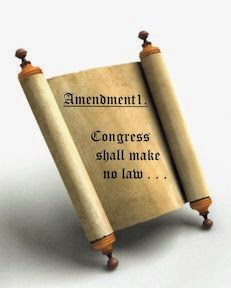
That’s because the amendment begins with “Congress shall make no law . . . .” It only applies to the federal government.

But wait, you say, what about states and cities and public schools? Doesn’t it cover them, too?

Technically, no. Practically, yes. It’s a convoluted path that begins with the 14th Amendment, which says in part:

No State shall make or enforce any law which shall abridge the privileges or immunities of citizens of the United States, nor shall any State deprive any person of life, liberty, or property without due process of law; nor deny to any person within its jurisdiction the equal protection of the laws.

A long line of U.S. Supreme Court cases, beginning in 1925 with Gitlow v. New York, have assumed that the First Amendment is incorporated into the 14th Amendment’s due process clause. In other words, conduct which violates the First Amendment (when done by Congress) also violates the 14th Amendment (when done by a state or local governmental body). So even though conduct by a state or local government is technically governed by the 14th Amendment, it’s just easier to talk about it as a violation of the First Amendment.

If a public library bans your book because of the subject matter or the position it takes on a particular issue, you may have an argument under the First Amendment as incorporated into the 14th. If a private bookstore refuses to carry the book for the same reason, you don’t.

But you may not be able to force the library to stock it, either. Although a public library is a governmental entity, it may have a perfectly valid reason to refuse to place the book on its shelves. Freedom of speech is not an unqualified right, as we will see in future posts.  

Next week we’ll start exploring those qualifications by looking at where speech is—or is not—free.

__________

*There are two exceptions: (1) when private individuals or entities engage in uniquely governmental functions, and (2) when government is heavily involved in the conduct of a private individual or entity. The details of these exceptions are beyond the scope of this post.

 
* * * * *

Kathryn Page Camp is a licensed attorney and full-time writer. Her most recent book, Writers in Wonderland: Keeping Your Words Legal (KP/PK Publishing 2013), is available from Amazon.com and other retailers. Kathryn is also the author of In God We Trust: How the Supreme Court’s First Amendment Decisions Affect Organized Religion (FaithWalk Publishing 2006) and numerous articles. You can learn more about Kathryn at www.kathrynpagecamp.com.


Thursday, January 23, 2014

A Writer's Guide to the First Amendment: Introduction


What does the First Amendment say, and how does it affect you as a writer? These are the questions I will be answering in my monthly posts in 2014.

Let’s start with the actual language:

Congress shall make no law respecting an establishment of religion, or prohibiting the free exercise thereof; or abridging the freedom of speech or of the press; or the right of the people peaceably to assemble, and to petition the Government for a redress of grievances.

Not all scholars agree on the number of protections in the First Amendment. Personally, I count six, divided this way:

Congress shall make no law (1) respecting an establishment of religion, or (2) prohibiting the free exercise thereof; or (3) abridging the freedom of speech or (4) of the press; or (5) the right of the people peaceably to assemble, and (6) to petition the Government for a redress of grievances.

Do you notice something strange about the way the amendment begins? It says “Congress shall make no law.” So why do the courts apply it to states and schools and other governmental entities? I’ll answer that question in next month’s post.

This month I’ll end with a bit of historical trivia that even Supreme Court justices get wrong. Did you know that the First Amendment was really the third? Congress sent twelve amendments to the states for ratification, but the first two didn’t pass.
 
So the third became the first.

* * *

Kathryn Page Camp is a licensed attorney and full-time writer. Her most recent book, Writers in Wonderland: Keeping Your Words Legal (KP/PK Publishing 2013) is available from Amazon.com and other retailers. Kathryn is also the author of In God We Trust: How the Supreme Court’s First Amendment Decisions Affect Organized Religion (FaithWalk Publishing 2006) and numerous articles. You can learn more about Kathryn at www.kathrynpagecamp.com.