"Hoosier Ink" Blog

Showing posts with label branding. Show all posts

Tuesday, January 10, 2023

Branding Explained with James Rubart

Branding matters. Even my grandson, at the tender age of six, understood that.

One day while lunching at our favorite fast-food restaurant, a text alerted my lunch buddy and I that a package awaited at our house. My mind whirled, wondering what we’d ordered that now rested on the front steps. We picked up the pace to finish our lunch and refill our beverages that we might head home to rescue the package.

 As we pulled up in front of our house, my grandson pointed through the mini-van windows to the medium-sized box pushed up against the front door. “Look, it’s from Wal-mart.”

 By now I’d surmised the package might contain Pop’s new coffee maker, but I couldn’t remember from where he’d ordered the replacement for our decade-plus-a-few-years-old appliance. With the vehicle safely stopped and shifted into park, I squinted up the sidewalk.

Dylan's announcement jogged the pieces of the recent purchase into place. Pop had indeed ordered the brew machine from Wal-mart.

We hopped out and the youngster scampered ahead as I called after him, “How did you know that?”

“The logo, Gram. It’s the Wal-Mart logo.” The smart young lad tapped the box. “See, the Wal-Mart logo.” He scooped up the box and waited for me to open the door.

Somehow this grandson who sees few commercials as his family’s television viewing derives from online, commercial-free sources was familiar enough with the Wal-Mart logo that he correctly, and immediately, identified it from some thirty feet away. I’d say that’s an effective branding story.

Like retail department stores, car manufacturers, and eating establishments, authors need branding, too. While we might understand, mostly, the WHY of branding for authors, huge questions loom about the HOW and the WHEN and the WHERE and especially the HOW.

On January 28 via Zoom, James L. Rubart will present “Author Branding Explained.” This two-hour chapter meeting will give us the tools to tackle the sometimes daunting, often confusing world of branding. 

The best-selling, Christy Hall of Fame, Carol, INSPY, and RT Book Reviews award winning author of ten novels loves to send readers on mind-bending spiritual journeys that they'll remember months after they finish one of his stories. He’s the co-author of the time traveling detective series, The True Lies of Rembrandt Stone, as well as an audiobook narrator. He lives with his amazing wife on a small lake in eastern Washington. Learn more about James on his website or connect with him on Facebook.

We'll see you on January 28. 


Friday, October 26, 2012

Interview with Author Eric Wilson

By Jeff Reynolds
Halloween's right around the corner, but you're having a hard time finding a Christian vampire novel to read? Is there such a thing? (Okay, I'm talking about a vampire story written by a Christian, not one about vampires who are also Christians.)
This month, I have the honor of interviewing Eric Wilson. Wilson has several novels and novelizations out, including Jerusalem's Undead Trilogy, which you've probably guessed is the Christian vampire stories I'm telling you about.
Jeff Reynolds: While my focus is more on the Jerusalem's Undead Trilogy, I can't neglect that three of the books you've written have titles that some people might recognize, like Flywheel, Facing the Giants, and Fireproof. (You also wrote the novelization for October Baby, which came out September 1st.) First, how did you get that gig? Second, did it require a lot of contact with the Kendrick brothers? Or was it more like being in a room after all the other kids left and having the toys all to yourself?


Eric Wilson: My publisher put me in contact with the Kendricks, knowing that they wanted novelizations of their films. After a long interview process, I was chosen to do the books. I had a blast. The Kendricks gave me lots of freedom. As long as I kept everything in the films in the books, I could add subplots and backstories. They were great to work with. We brainstormed and laughed, then I tucked myself away and wrote like crazy (with each book being completed in 4-6 weeks).

JR: I've read the first of the Jerusalem's Undead Trilogy, Field of Blood. (The other installments are Haunt of Jackals and Valley of Bones.) What inspired this series?
EW: I was, and still am, annoyed with the amoral view of vampires in current culture. Traditionally and symbolically, they represent evil. They are a counterfeit of Jesus's blood providing immortal life. I wanted to write a trilogy for the mainstream market, without Christian lingo, that would go back to historical and biblical foundations for the concept of vampirism. My foundation for the stories started when I saw an article from Jerusalem, describing a 2000-year-old family grave discovered in the same field where Judas hung himself. What if Judas's blood had seeped into those graves? I had to explore the idea. I've traveled in Romania and Israel, so those countries were great inspiration for the setting.

JR: On your website (address given below), you wrote in a letter to critics: I've always aimed to reach those on the fringes of faith--ones who have wandered from the church, but still have a seed of belief; and ones who are too nervous to come through our doors, yet have a desire to know more about the God we serve. How has God used your books in general and the Jerusalem's Undead Trilogy specifically in reaching those you've described?
EW: Sadly, the Christian market is more intent on providing "safe" alternatives than world-changing art, whether in music or literature. That means it is very difficult in this market for a writer to reach those outside the church. Many Christian consumers want tidy stories with easy lessons and black and white morals, though in the real world, life doesn't always work that easily. I've tried to write stories (aside from the novelizations) that are nuanced in character development and biblical ideas. They're not tied up with pretty bows. I've found a core readership of Christians who love the multifaceted elements of my books.

With the Jerusalem's Undead Trilogy, I also found a core readership of nonbelievers. I've received numerous emails about the powerful symbolism of the thorns (sin) in the veins. I've had people say they were about to go feed their own addictions (fill in the blank), then thought of those thorns and chose not to do so. I've had others tell me they had never read a Bible, but went and bought one after reading the trilogy so they could learn more about the Nazarene Blood. It's been a great launching point for dialogue about sin, infestation, and the power of redemption and grace versus the attempts to find freedom on our own good efforts (such as Gina tries to do at the end of book one).

JR: Last year we had a speaker at the ACFW Indiana Chapter talk about branding. It seems having both Facing the Giants and Field of Blood in your bibliography isn't a textbook example. How do you/your publisher effectively market books intended for two distinct and not necessarily compatible audiences?

EW: I've never cared a whit for branding. I care about writing what God puts in my heart, but my ideals tend to get in the way of practical concerns. To my detriment, that has affected my sales. Some people doubt that the guy who wrote Fireproof could write a good vampire story. Others wonder why a guy who wrote a highly original vampire trilogy would waste his time with preachy storytelling like Facing the Giants. The reality is that I'm an out-of-the-box thinker, constantly wrestling through scriptural issues, but I'm also deeply committed to the Bible being the truth. Both aspects are part of who I am. I try to be true to that.

JR: Christian vampire stories sound a bit unorthodox (though it's clear the Collectors in your series technically aren't vampires; in Field of Blood one mentions they like the taste of garlic). How controversial has this trilogy been? If so, how do you use the controversy to your advantage as an author?
EW: Vampires are a demonic representation of evil, always have been traditionally. In that sense, my Collectors are very much vampires. And most novels nowadays have played with those old standbys--garlic, mirrors, and such. I didn't ever write this as a "Christian vampire" trilogy. First, it's not Christian vampires. Second, I wanted it to reach nonbelievers.

The controversy only came from those who hadn't read it and assumed I was "of the devil" or I was trying to "cash in on the
Twilight books by fleecing the Christian flock." If people don't do their research and know a little about me (I'm a deeply devoted Christian, husband, with a Bachelor's degree from an accredited Bible college), then I don't worry too much about their jabs. But, the reality is that the trilogy would've sold much better outside the Christian market.

When Thomas Nelson first signed me for the trilogy, they had an imprint called WestBow that was aimed at mainstream readers. That imprint folded soon after I came on board, and that meant the trilogy got bogged down in an Amish-driven market of that time.

JR: More recently, in addition to the October Baby novelization, you've written a novella and have released the first two installments of a new series. Would you like to tell us about these?
EW: For my own career survival, I've tried to be more aware of branding. My more recent books have been more specifically written for the Christian market, while still dealing with complex issues.

One Step Away
is about a modern family targeted by a shadowy figure from their past. When they get $6,000,000, they don't realize they are part of an experiment. On a twist of the story of Job, they are blessed instead of cursed to see if they will turn their backs on God.Two Seconds Late is a modern twist on the story of Esther. A young woman is dating a state politician, and she discovers a conspiracy to get human tracking implants legalized, for the safety of children and the elderly. She has no idea that big business, politics, and even a Russian assassin have stakes in this, and she alone has been raised up for "such a time as this."October Baby was a blast to write. Based on the screenplay by Theresa Preston and the Erwin brothers, it is a nuanced story. about a 19-year-old girl who discovers that her parents are not her birth parents. In fact, she was an abortion survivor. This sends her on a coming-of-age quest to find her birth mother and the facts surrounding her birth. I was able to add subplots and layers. The book will make you laugh and cry. It's full of humor, drama, a bit of romance, and somehow avoids getting preachy on this delicate subject. The abortion-clinic nurse is one of the heroes of the story, for example.

JR: Thank you for your time, and have a blessed day.
EW: I appreciate it, Jeff. Thank you. May all of us discover the power of the Nazarene Blood, and be free from the thorns that try to entangle us.

Eric Wilson's Webpage: http://wilsonwriter.com

And if you'd like to see the trailer for either Field of Blood or One Step Away? http://www.youtube.com/watch?v=4t9GUMhY7N8


Wednesday, September 19, 2012

Interview with Author Jill Williamson

Today I'm pleased to interview award-winning author Jill Williamson, who enjoys creating "weird books for teens." Let's get started!

Jill, you've been a reader since childhood. At what stage in life did you realize you wanted to write for publication?

Jill Williamson
Not until I was about twenty-six years old. I had recently left the fashion industry, which had always been my dream. My husband and I were very involved in our church, working with teens. I wanted to do some kind of speaking to teens, to motivate and encourage them.

I discovered that sometimes, people hire speakers based on articles written by the speaker. So I looked into writing articles. Then the new Harry Potter book came out, and a new barrage of debates within the church community flared up as to whether or not the books were bad for Christians to read. The debate inspired me to write my own teen novel that all Christians would love. Yes, I was very naive. I have since learned that no one likes every book. But that’s how I got started. I was inspired to try and write blockbuster-style stories for teens that glorified God.


You've been published by the large firm Zondervan and by the newer and smaller Marcher Lord Press. Please share some of the differences in working with distinctly different publishers.

The editorial timeline is a much slower pace at Zondervan. Everything happens right before the release at Marcher Lord Press. Zondervan has more money to pour into marketing, where Marcher Lord Press has limited resources. Also, and probably the biggest difference, is that Zondervan books are stocked by bookstores. Marcher Lord Press sells primarily online. With Marcher Lord Press, since there are only two employees, I tend to get answers to my questions right away. Zondervan can take longer.


You've written fantasy, sci-fi, speculative contemporary fiction... Because author branding is much discussed, how do you view branding as it applies to your own writing? Can you categorize the fruit of your imagination?

For me, as long as it’s weird, I can write it. Anything that falls under the umbrella of speculative fiction is fair game. Yes, author branding is important, and I could have tried to become the medieval fantasy lady, and probably been more successful, but that’s not me. I’m far too random of a human being to stay that focused.


Your latest release, The New Recruit, is unlike anything I've read before. Please share a few words about it, including how the seedling for that idea first took root in your imagination.

The New Recruit is about a boy who is recruited into a spy organization that fights both the supernatural and groups that set out to turn people from Christ. Here is the back cover text:

Forced to choose between military school and a Christian spy organization, skeptic Spencer Garmond signs on with the Bible geeks. But before he even boards the plane for Moscow, Spencer realizes this is no Bible club.

These guys mean business.

Stumbling onto a case involving a gang of homeless boys, a chilling tattoo, and the always beautiful Anya Vseveloda, Spencer struggles to find the faith needed to save the Mission League from enemy infiltration.

This was the very first book I ever wrote. I pieced it together in a very backwards way. I was trying to write a story about teens going out into the world like missionaries, but since teen fiction books about missionaries weren't getting the attention of agents and editors, I thought, let's tweak the story and turn them into undercover agents.


How far into the future do you plan your stories? Are you planning the next one while writing the current one, or do you take them one story at a time?

I always have several ideas in my head. I try to stay loyal to one until it’s finished, but that doesn’t usually work. So, oftentimes I’m writing one story, and then I need to take a break to work on brainstorming a new idea and writing the proposal. Once that’s turned in, I go back to the story I was writing. I’d rather not bounce back and forth, but I think that’s how it has to be when you release multiple books in one year.


It's no secret that writers' choices of reading material help to shape their creativity. Name some major literary influences in your past reading.

Books I loved as a child: Nancy Drew, Little House, Anne of Green Gables, The Hobbit, the Narnia books. When I grew up, books I loved: John Grisham, Peretti, Francine Rivers, Tolkien. And I wasn’t really inspired by books to become an author. Once I began to write, so many authors inspired me. Here is a list of authors that have impressed me in one way or another: Frank Peretti, Ted Dekker, Megan Whalen Turner, JK Rowling, Rick Riordan, Scott Westerfeld, Robert Liparulo, Melody Carlson, Robin Jones Gunn, Bill Myers.


Share a few words about your relationship with your literary agent, Amanda Luedeke of MacGregor Literary. When and how did you get acquainted? Had you communicated with other agents before Amanda?

I’d had an agent prior to Amanda. And my previous agent was a good man and a good agent. But he wasn’t the right agent for me. So beforeI met Amanda, I was agentless, and I’d been praying for someone who really loved my writing. I wanted more than an, “I can sell this.” I wanted someone who actually liked my stories. When I saw that Chip MacGregor had added Amanda as an agent and that she was going to be at the Oregon Christian Writer’s conference (her first conference, I think), I felt like God created an agent just for me. I saw Chip and mentioned that I’d signed up to speak with her, and he went out of his way to introduce us. (That was so cool, by the way.) And one of the first things Amanda said to me was, “I really like your writing.” I was so happy. I didn’t care that she was brand new to agenting. She was the answer to my prayer. And she and I get along really well. I’m very blessed to have her on my team.


So far, you've been targeting young-adult audiences. Are these the readers you want to stick with, or do you have plans to write for adults too?

I have no desire to write for adults. I suppose I could. And my Blood of Kings trilogy was considered adult by my publisher, even though I consider it YA. But I feel called to write for teens. I’m always open to change, but I don’t see that happening in the near future.


You're a wife and mom, which undoubtedly demands much time. How do you manage to carve out hours (or minutes) for creative writing?

My kids are in school now, so I have all day, Monday through Thursday (only four days of school where I live) to write. Summers are harder. My husband is very supportive and does a lot with our kids to give me the time I need.


From your own experience, give one piece of advice for writers who have been studying and polishing their writing craft but who want to improve and grow in their skill. 

Just write more. The more books you write, the better you’ll get. And you can go back and rewrite old stories. But nothing is better than putting in time at the keyboard.


Are you working on any more books? If so, can you tell about them?

I’m working on Captives, which is the first in a dystopian trilogy coming out from Zonderkidz next February. It’s based on Daniel 1, when Jerusalem in conquered by Babylon and the young people are taken into the city.


Do you have a website or blog where readers can find out more about you and your work?

Yes, here are my links:


Thanks, Jill!

--Rick Barry

Monday, June 7, 2010

Does a Writer Need a Logo?

Maybe the simpler question to answer is, can a writer get by without a logo? The answer would be, yes – you certainly can.  But, ... you'll be working much harder when making a first impression than writers who do have one (just like everyone in every other profession).

It is very cliche' but there is definitely a bit of truth hidden in the saying that a picture is worth a 1,000 words.  When you have only moments to make a first impression; any advantage you can get is going to be helpful.  A well-crafted logo can help you appear professional, organized, creative ... or even reflect a particular writing specialty that is your niche'.  And a logo can do that, before they read a single word about your latest pitch!

First impressions matter. In a world where everyone is inundated with too much information on a daily basis, we are left to hope against hope that someone will notice our writing, make the time to read it, and fall in love with it (and then champion it on our behalf to those with the power to say yes or no to its publication.)

The font choices, colors used, and design style of a logo can say a lot about you - even without using the stereotypical ink pen, quill, book or typewriter that are often used symbols of the writer's trade. For instance, if you consider yourself a chic lit writer, are you a writer of warm and fuzzy romance, or do you go for edgier female topics and handle them with gusto?  You can hint at your writing style with a feminine script font and your choice of color.  A softer pink or rose for a romantic vs. a bolder red instantly make a statement about your style.  Or, maybe comedy is your writing genre of choice.  A bright, and vibrant color such as orange, yellow, or shocking pink or green enhance an instant sense of fun being afoot!  Add in a fun (yet readable) font and your logo has made an instant statement on your behalf - even before anyone has had the chance to meet you, or read your query or proposal.

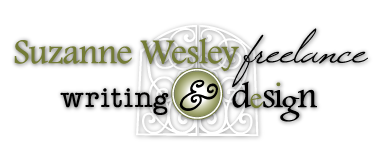
The below is my own logo, what first impression does it give to you?  I'll discuss any responses I get in next month's blog post ... where I will also reveal my related business tag-line.  Tag lines are another part of personal/professional branding to consider for successfully marketing your writing talents.

Blessings,
~ Suzanne Wesley
www.suzannewesley.com

Tuesday, January 26, 2010

Finding A Platform (And Other Arguments With Myself)


I recently read an article about the importance of having a platform and branding to attract a publisher and sell books. It had a lot of good things to say but this topic has always left me with a big question mark. I'm a fiction writer. I'm more of a jack-of-all trades than an expert at any one thing. This applies more to nonfiction authors, right? Someone who writes a book about finances has a built-in platform of financial expertise and can travel the country teaching people valuable lessons about managing money. But fiction authors write about all sorts of topics/themes and may not be an expert at any of them. In my first novel, Snow Angel, the theme is the classic redemption story of God's love. Duchess and the Dragon is finding your own faith and growing in that, Wind Dancer - spiritual warfare, Love's First Light - forgiveness and my latest book, Angel's Den, domestic violence. While writing and researching these books I learned a lot, but I don't feel qualified to get behind a microphone and claim to be an expert at any of these themes. (Never mind that pesky fear of public speaking). When it comes to branding myself and platforms I've always felt clueless. What am I an expert at? What knowledge or ability do I have that other people would like to learn?

It's at this point that many authors become writing coaches. I think this is great, and I try to help out aspiring authors as much as I can, but I don't think "teaching" is my gift. I function too much on gut instinct and don't know how to convey that as a teacher. What, if anything, do all my books have in common? Romance and history. I could build a platform around historical research and target history lovers. I've seen some pretty impressive websites that dive into world of the Regency period or have a Jane Austen look and feel but my books are set in different locations and time periods which would mean a separate website for each book. Not very practical and that narrows my playing field to history lovers. I've noticed that people either love history or couldn't care less.

Okay, what about romance? Love? Hook-ups? Hmmm. Now there is a huge topic and I am a big fan. When I look at the kinds of books/movies/TV shows I read and watch, I definitely find a lot of romance. And if I ask myself what my dream career would be second to writing, I think I would say matchmaker - that would be seriously fun! I love it when two people fall in love. Do I have a passion for romance and helping people find their mate? Yes! Yes, I do!

In asking myself a few questions, I have discovered a possible platform that I am really excited about. I'm not sure what it will look like yet, but my immediate response to articles on branding has gone from shoulder shrugging to an eagerness to start writing blog entries about finding love. That's a start and who knows where it might go from there? Sometimes we box ourselves in because we lack the faith and vision that God sees for us. In this area of finding my platform, that is exactly what I have been doing.

How about you? Are there any areas in your writing career that you've felt clueless about? Do you think fiction authors need a platform, branding, taglines, etc? I'm excited to hear your thoughts!
Jamie Carie