"Hoosier Ink" Blog

Showing posts with label imagination. Show all posts

Tuesday, August 1, 2023

Missing Details

I came to the last page of a crime novel, closed it and laid it aside. It had been a fast-paced, satisfying read. As my mind walked through the plot and visualized scenes where the robberies had taken place, I also tried to visualize the robber, but couldn’t. The author had not described him.

For one of the crimes, the protagonist had worn a disguise with brown contact lenses, but the author didn’t say what his natural eye color was. Another crime, another disguise—this time he was an elderly man with a gray-haired wig. Again, the author didn’t say what his real hair color was.

My wife read the novel at the same time. If the police interviewed both of us as witnesses to those crimes, I imagine each of us would give them different descriptions of the perpetrator because most of our details would come from our imaginations.

Readers don’t need highly detailed descriptions to enjoy a story because readers like to participate in the creative process with us. In fact, the more details they supply, the more likely they are to enter “the fictive dream”—the imaginary world that takes us away from our current surroundings.

Media expert Marshall McLuhan categorized some media as “hot” because they supply detailed, multisensory information that leaves nothing to the imagination. Movies are good examples. McLuhan called other media “cool” because they supply sketchy information and we must create the rest with our imaginations. Books are “cool” media. (But you knew that, didn’t you?)

There’s another advantage of providing scant details: It keeps the pace of our narrative moving. If we don’t belabor our description of characters and settings, we create stories that readers truly can’t put down because they’re eager to see what happens next.


Joe Allison writes both fiction and nonfiction, and has been a member of the Indiana chapter of American Christian Fiction Writers since 2010. 
He lives in Anderson, IN, with his wife Maribeth.

Tuesday, December 6, 2022

Your Dream Writing Life

A few weeks will bring us to January, named for the Roman god Janus, who faced both the future and the past. It’s a good time to reflect on the year just ended and dream of the year beginning, so let me challenge you to an exercise that a workshop leader once gave me: Describe a day in your dream writing life. Include plenty of sensory clues, because these will help you enter the dream and prompt your subconscious to make the dream your reality.

Here from my notebook is how I described my dream writing life in 2019:

I am strolling along the sidewalk in Saugatuck, Michigan, admiring the colorful gifts in shop windows. It's a sunny autumn afternoon and a balmy breeze from the harbor scatters leaves before me. I feel a sense of elation as I approach the corner bookstore where a signing of my new book has been scheduled, because I can already see that a couple dozen people are browsing the tables outside the shop and going inside. We'll have a busy afternoon.


When I step inside the shop, the manager greets me warmly.  She offers to make me a cup of tea before she seats me behind a table where two large stacks of my novel are waiting to be signed. My tweed jacket feels a bit warm, but I decide to keep it on because I like the professorial air it gives me. Immediately, a vivacious lady introduces herself and says, "I've been looking forward to this, Mr. Allison. I've read all of your books and can hardly wait to read this one tonight!"


I inhale the smell of fresh paper and ink that pervades the shop. It reminds me of so many pleasant afternoons I've spent in Borders, Barnes & Noble, and other bookstores, exploring the world of knowledge and imagination. It's satisfying to know that now I am part of that world.


You might say this is not a very realistic picture because the writing life is primarily one of hard discipline and frustration. The days of seeing our work in print and talking with enthusiastic fans are few and far between. Fair enough. But remember, our assignment is to capture the dream, not the many weeks of hard work that lead to the dream. Delightful rewards beckon us into the future, so we need to see them clearly at the turn of the year.


Now a savory cup of Earl Gray tea or the fresh-ink fragrance of Barnes and Noble reawakens my dream within me. It’s still very much alive, luring me into the new year.

How would you describe your dream writing life?

Joe Allison writes both fiction and nonfiction, and has been a member of the Indiana chapter of American Christian Fiction Writers since 2010. He lives in Anderson, IN, with his wife Maribeth and daughter Heather.

Tuesday, December 1, 2020

The Creative Power of a Name

A well-chosen character's name can shape our expectations for that person's story, often in subtle ways.

For example, I’m developing a story set in the Great Depression. Its protagonist is a young single woman who wants to leave her hometown in Appalachia to find a new life in “the big city” of Charlotte. I’ve given her the name Ruth Saylor. As Ruth’s story unfolds, we learn that she grew up in a devout Christian family and has a reputation for loyalty. Her plans are interrupted by the death of close family members, but she perseveres in faith. She eventually finds fulfillment and joy in a place she doesn't expect.

If a reader is familiar with the biblical story of Ruth, these features of the new Ruth’s story will seem very natural. And if not, her name nonetheless telegraphs that she is an intrepid young woman seeking a foreign land (saylor=sailor). In either case, her name helps to tell her story.

Theatrical agents understand this dynamic, so they often give an evocative stage name to a rising star. Audiences probably would have expected to see a matronly lady introduced by the name of Ethel Gumm, but her new name of Judy Garland suggested wholesome youthfulness and superlative talent. A young man introduced as Benjamin Kubelsky might have seemed a tad pretentious. But when he used the name Jack Benny, no one took him too seriously, like the stand-up comedian he was.

An evocative name can imply a person’s character. Perhaps it has an onomatopoeic quality (e.g., the echo of laughter in “Benny” or the corroded hinge of “Scrooge”). Or it may hint at a character’s motivation (e.g., a “Saylor’s” yearning to explore distant lands). However, I don't recommend using a name that literally denotes a character’s role in the story (e.g., John Bunyan’s “Christian” in Pilgrim’s Progress). While that technique was common in allegories, allegorical narratives have few readers in the twenty-first century. 

Occasionally, a character's name may even suggest a plot for that person's story. As I was shaving a few days ago, the name Sam McKittrick came to mind. I had not been trying to name a character, it was not the name of someone from my past, and a quick Google search did not identify any well-known person whose name that I may have collected subconsciously. So I turned it over in my mind, rolled it around my tongue, and spoke it aloud a few times. I liked the sound of it, so I made a mental note and went on with my business.

Since then, I’ve caught glimpses of a fellow who might be Sam McKittrick. He’s in his sixties with a balding head and impish grin. He wears a tweed jacket that smells of cherry-infused pipe tobacco. He isn’t ready to talk with me yet, but I won’t impose any contrived character qualities to hurry him along. Sam knows he has a sympathetic listener here, so in due time, he will speak. Then we’ll see what sort of story he may have to tell.

"What's in a name?" Shakespeare famously said. "That which we call a rose, by any other name would smell as sweet.” True. But it would change our perception of the flower, wouldn't it?

Saturday, July 4, 2020

"The Book Was Better"


Have you ever seen a movie based on a book you loved? You probably left the theater telling your friends, “The book was better.”

Even if the movie featured some of your favorite actors and jaw-dropping special effects, odds are you remembered the book as a more colorful, emotionally engaging version of the story than what you saw on the big screen.

That’s how I felt when I saw Francis Ford Coppola’s 1974 version of “The Great Gatsby,” starring Robert Redford and Mia Farrow. The novel was a real watershed experience of my high-school years. It gave me an immersive experience of the “Roaring Twenties.” But the movie was disappointing. Why?

Best-selling author Jerry Jenkins would say it was because the book had triggered the theater of my mind. It sparked my imagination instead of telling me in detail what happened. My imagination supplied a much more vivid picture of the story than what Hollywood could give me in the theater. This is a key advantage that a book has over a movie.

It’s also a clue to what you and I must achieve in our writing. Instead of giving the reader a detail-laden description of every scene and every character, we need to suggest these things to the reader and allow her to enjoy the fun of imagining it for herself.

“The best description suggests just enough to ignite the reader’s mind,” Jerry says.

So how much is enough? Just enough to point a reader in the direction the characters are going, then gets out of the way. Put your reader in the driver’s seat. Evoke the reader’s feelings about your characters, setting, and time period. The reader will see a somewhat different picture than you do—and that’s OK. The reader now owns the story as much as you do.

Your book is the reader’s ticket to another world, not an illustrated encyclopedia of that world. Just point the way and let your reader paint the scene.

Saturday, September 8, 2018

The Grape on the Floor

by Jean Kavich Bloom

Honestly, I was listening to the day's leader talking about psalms with our church writers' group, but I was also a bit distracted. We were all sitting at a circle of tables in a classroom, and in the middle of the floor, right in front of me, was a lone, green grape. I assumed it had been dropped by someone in the class that always meets in there just before we do, the class that always has goodies to keep them, I guess, fortified while they study the Word. 

But it looked so lonely, that grape. 

To get my mind off it, and because I do odd things, I wrote at the top of a blank piece of paper, “The Grape on the Floor.”

The fellow writer next to me saw it. Later she said, “You’re going to write about that grape on the floor, aren’t you?”

Yes. Yes, I am. Because, you know, what was going to happen to that perfectly good (except for, you know, being on the floor) grape?

Would someone pick it up, wash it off, and eat it?

Would someone pick it up and just throw it away?

Would it be kicked around and end up in the hallway somewhere—or even down in the kids’ wing of the church before anyone else noticed it?

Would it be tragically squished by an inconsiderate and oblivious human foot before it had a chance to somehow save itself?

Didn’t anybody care about that grape? Did it miss its bunch?

Okay, it was just a grape, and I later left the room without giving it much more thought. I would have had to move a table or (gasp) crawl under one to get the grape myself, and I knew the cleaning crew would soon be there. (I could find a lesson in that too. Leaving a problem for someone else to deal with?) But my point is that imagination can take us fiction writers so many places if we just let those brain cells fly.

             What (or who) do you see “out of place”?

Why do you suppose it (or that person) is “out of place”?

How did it (or that person) get there?

What will happen to it (or that person)?

Who will care? Will anyone care?

If you see a “grape” that intrigues you, take a moment to do the odd thing. Write down what you saw. Who knows? What you saw might lead to some fruit of your own. 


Jean Kavich Bloom is a freelance editor and writer for Christian publishers and ministries (Bloom in Words Editorial Services), with more than thirty years of experience in the book publishing world. Her personal blog is Bloom in Words too, where she has posted articles about the writing life. She is also a regular contributor to The Glorious Table, a blog for women of all ages. Her published books are Bible Promises for God's Precious Princess and Bible Promises for God's Treasured Boy. She and her husband, Cal, live in central Indiana. They have three children (plus two who married in) and five grandchildren.


photo credit: https://www.publicdomainpictures.net/en/view-image.php?image=35481&picture=bunch-of-grapes

Saturday, January 7, 2017

When Characters Come to Life

While spending Christmas Eve and Christmas Day at the Abe Martin Lodge in Brown County, I was surprised to learn that the renowned tourist attraction is named for a character of fiction—a cartoon character to be precise. Hoosier artist Kin Hubbard conceived Abe Martin as a backwoods philosopher who commented on the political scene, family life, and a wide range of other topics with more candor than a proper editorial writer could have. You’ll find sketches of Abe and his cohorts all over the inn, as well as the nearby tourist haven of Nashville.
I wonder how many other states have named public works after characters of fiction. Indiana may be unique in that respect. Hubbard drew the character so clearly and expressed his opinions so winsomely that Hoosiers now give old “Abe” as much deference as a real person.
While there, I read the autobiography of Anthony Trollope, a 19th century British satirist who is best known for the Barsetshire Chronicles, a series about the foibles of clergy in an imaginary Anglican parish. Trollope says that the series “failed altogether in the purport for which it was intended” (i.e., to end a system that allowed clerics to use endowments for the poor to feather their own nests). “But it has a merit of its own… The characters of the bishop, of the archdeacon, of the archdeacon’s wife, and especially of the warden, are all well and clearly drawn. I had realized to myself a series of portraits, and had been able so to put them on canvas that my readers should see that which I meant them to see. There is no gift which an author can have more useful to him than this.”
Most of Trollope’s work is now forgotten, but the Barsetshire Chronicles remain in print and became the basis of a “Masterpiece Theater” series by PBS some years ago. These characters still live in the imagination of millions of readers and TV viewers.
How do such characters “come alive”? In these blog posts, we talk a good deal about the techniques for evoking them, but notice Trollope’s comment about how his characters began to take shape: “I had realized to myself a series of portraits,” he says. He visualized each of them as vividly as if he were standing before their portraits, studying every eyelash and wrinkle with appreciation. Only when he saw them in his imagination did he “put them on canvas” so that readers could see them as well.
Do you see your characters that clearly? In Trollope’s opinion, it's the most useful gift an author can have.


Joe Allison has been a member of the Indiana Chapter of American Christian Fiction Writers since 2010. He lives in Anderson, IN. His non-fiction books include Setting Goals That Count and Swords and Whetstones.
 

Saturday, June 4, 2016

Come with Me

My wife, Judy, died five months ago and I am learning day by day how to adjust to her absence. As I told a friend at church last Sunday, I feel like a mariner who has crossed the equator: I still have my sextant and compass, but I must learn how to navigate all over again.

In our 41 years of marriage, Judy and I shared life on the most intimate (and, some would say, trivial) levels. One of our favorite pastimes was to go for long drives, just to see what we could discover together. On such a drive last July (with Judy at the wheel), we struck out east from Anderson and chose our turns as we went. We saw Wilbur Wright's birthplace, stopped for a soft-serve ice cream cone in Winchester, and realized just before sundown that we were near the Ohio state line.

All along the way, I shared my memories of growing up on a farm in East Tennessee. I got plenty of memory prompts from the hay fields and cornfields of eastern Indiana that July afternoon! In fact, each of us interrupted my childhood narrative often to comment on what we saw, smelled, and heard as we wended our way toward Ohio. Our running commentary ("Look at the snowy egret beside that pond." "This fresh-cut grass smells like a ripe watermelon," etc.) seared the memory of that drive in my mind. What I miss most about Judy is the opportunity to share those incidental observations of daily life--call them the "trivial" things if you like. I still find myself spontaneously saying things like, "I just heard a sand hill crane. There must be a flock overhead."

I felt depressed yesterday afternoon, wishing I still had a companion to share these rich trivialities of daily life. I wondered, Who could I invite to come with me now?

Immediately, the thought came: My readers. They enjoy yarns of days gone by, as much as Judy enjoyed the story of my life as a farm boy, but they want just as much to experience the sensory details along the way. I don't have to tell them what the details mean with respect to our journey or destination, though the details should have some significance for the story; I can simply call these things to our attention and let their significance unfold.

Vivid description does that. So does authentic dialogue. In fact, everything in a well-told story should sear the memory of it in the reader's mind.

I'm thinking I ought begin every story by saying to the reader (in my imagination if not on paper), "Come with me. Let's see what this world looks like today."

Joe Allison has been a member of the Indiana Chapter of American Christian Fiction Writers since 2010. He lives in Anderson, IN.


Saturday, November 1, 2014

Not to Put Too Fine a Point on It

We like to have a well-defined vision of our story world--character quirks, colors and fragrances, even weather changes that affect the mood--but we don't have to describe all those details to usher our readers into that world. In fact, skillful storytellers know what to leave to the imagination. An example:
The early morning sky, rinsed clean by the recent winter rains, curved overhead as though it were an inverted bowl. Ruth, striding toward the well, paused for a moment and tipped her head to look at it.
If we could find a clay that would turn blue when it was fired, she mused, how beautiful the pots would be. Or even a blue slip to trace on the outer surface of the bowls. Wouldn't it be lovely?
A familiar voice pulled her attention away from the sky.
"What are you looking for--birds to trap for dinner?"
Ruth grinned. The woman coming toward her was her sister but as unlike Ruth as it's possible for sisters to be. Small and oddly fair for a Moabite, Patima bore no resemblance to her tall, dark sister. Nor did her pointed, elfin face have any similarity to Ruth's calm, serene face with its broad forehead, winged brows and wide, mobile mouth. 
In 158 words, Lois Henderson sets the scene and introduces the lead characters of her best-selling novel, Ruth (Christian Herald Books: 1981). How old are these women? Which one is older? Where is the well--in a village, a forest clearing, beside a hard-packed clay trail? Is either one carrying a vessel to fetch water? Is it a jug, a pitcher, a tall amphora? Of carved stone or fired clay? What color? What are they wearing? Are others at the well?

The author tells us none of these things, so our imaginations supply the details. She surely considered these things, and may even have filled notebooks with these ideas before she began to write, but she didn't spell them out in the narrative itself. She left that to us, the readers.

Want to use the best techniques of creative writing? Then don't put too much detail into your story. Otherwise, there can be no creative reading.

Best wishes to our NaNoWriMo marathoners this month!
__________________


Joe Allison and his wife, Judy, live in Anderson IN, where Joe serves as Editorial Director of Discipleship Resources & Curriculum for Warner Press, Inc. Joe has several nonfiction books in print, including Swords and Whetstones: A Guide to Christian Bible Study Resources. He's currently writing a trilogy of Christian historical novels set in the Great Depression.

Visit Joe's blog at http://southernmtns.wordpress.com

Saturday, July 5, 2014

To Wake, Perchance to Dream

Famed New Yorker humorist James Thurber was an incorrigible daydreamer. His wife disturbed his reverie at cocktail parties on more than one occasion by spitting out an expletive and commanding him to "stop writing." Fortunately, he didn't, and we got some of his funniest stories as a result.

My wife Judy is an accomplished daydreamer, too. She hates to shop for groceries, so when I go into Kroger's to pick up a couple of items after work, she prefers to stay in the car. It's not unusual for her to open the conversation when I return with something like,

"See that broad-shouldered fellow in the red plaid shirt and cowboy boots? He was abducted from the banker's family when he was a child and they refused to pay a ransom so they never saw him again. The story came out years later, when he married that mousy woman in the gray flannel coat, who proved to be his sister. Her parents died long before she met him, and they'd spent her inheritance trying to find him..."

I'll never lack for a good plot while we have these parking-lot moments!

One other thing about Judy: When she turns out the bedroom light, she'll often roll over and say, "Tell me a story!" That flustered me until I began to cultivate the art of daydreaming. If she asks me now, my first thought is, What people did I see today? And what might be their stories?


__________________

Joe Allison and his wife, Judy, live in Anderson IN, where Joe serves as Editorial Director of Discipleship Resources & Curriculum for Warner Press, Inc. Joe has several nonfiction books in print, including Swords and Whetstones: A Guide to Christian Bible Study Resources. He's currently writing a trilogy of Christian historical novels set in the Great Depression.
Visit Joe's blog at http://southernmtns.wordpress.com


Saturday, December 7, 2013

I'll Take You There

My daughter had hit a rough patch in her marriage. She and her husband were seeing a Christian counselor, but the emotional stress seemed more than she could bear. In desperation, she sent me a text message: "I wish I could be with you guys right now."

What could I do? Much as I wanted to relieve the pressure she felt, I dare not suggest that she pack her bags and come home to Mom and Dad. That would only make her problems worse. But I could offer her another kind of escape...into the world of imagination. So I texted back:
Let’s go to Granny’s porch to eat some watermelon...The sun’s just gone down and the jar flies are singing (ee-oh-ee-oh-ee-oh-ee-oh-eeeee). Tell me what you see.
This memory came from an evening we actually shared at my mother's home in Tennessee twenty years before.  It was a pleasant, peaceful memory for all of us. We couldn't actually go there anymore because my mother had been in an Alzheimer's center for years, and that house was sold long ago. But my daughter texted back:
I see Bouncer and Cricket [Granny's dogs] doing laps around the perimeter of the yard, trying their darnedest to teach those squirrels a lesson…I see Uncle Dan and Keith crafting a complicated firework cannon with Coke cans and duct tape…Howard is bringing a handful of fresh veggies up from the garden…corn, ‘maters, zucchini…
Together we recreated this scene from our past, and it became a soothing balm for my daughter's spirit. She later said, "With that one message you wrapped your arms around me, Daddy (through a veil of tears)…"

I believe this is an important way God can use the stories we write. With just a few descriptive hints (e.g., the jar flies' song), we can take readers to another time and place to gain a fresh perspective on what's happening here and now. Don't disdain the value of "escapist" fiction, because sometimes our readers need exactly that: an opportunity to withdraw from the heat of the battle to be refreshed and renewed. We can spirit them away to such a place, using memories that we have in common.

__________________

Joe Allison and his wife, Judy, live in Anderson IN, where Joe serves as Coordinator of Publishing for Church of God Ministries, Inc. Joe has several nonfiction books in print, including Swords and Whetstones: A Guide to Christian Bible Study Resources. He's currently writing a trilogy of Christian historical novels set in the Great Depression.

Visit Joe's blog at http://hoosierwriter.wordpress.com

Sunday, June 2, 2013

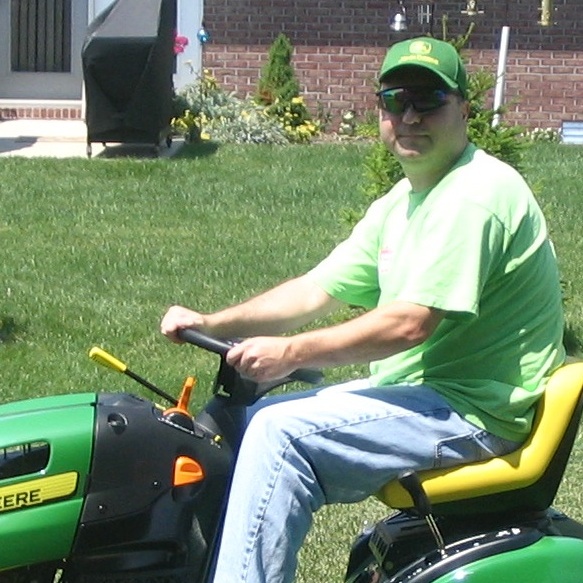
Writing From the Seat of My John Deere

Where does my iPad plug in?

By Darren Kehrer

Ok, so you might be wondering if this is even possible (or you might be thinking that I just sit in my garage or in my backyard on my tractor while writing). Now I’m not saying that this is a guy thing, but when I’m out mowing the grass, the world fades away and my mind clears. My only task is to follow the grass lines, avoid running into trees, and watching out for a previous visit by one of the many neighborhood pets.

Through out the act of mowing the lawn, the stress of my day flows away and my right side, brainstorming mind has a chance to breakthrough the storm clouds of a stressful day. Actually, many times, I just starting writing “what if this happened” scenes in my mind. Other times, on the movie screen in my head, I start filming the motion picture adaption to something I’ve already written (awesome surround sound, outstanding special effects, and the cast of my choice at no cost to me).

Stress is to creativity what water is to fire. Stress kills your ability to create, it blocks the flow of ideas, and it extinguishes the flame and passion of why you write. For me, my daily (non-writing) work life soaks up most of my time, so I’m happy with whatever, wherever, and however creative writing ideas get a chance to fan the creative flame.

But the other day, yes while mowing, I found myself wondering if any other of my writing friends might have “strange” or “odd” places that they brainstorm. That said, I wonder what your answer might be to that question, keeping it family friendly (of which I had no doubt).

Tuesday, June 26, 2012

The (True!) Joys of Having ADD with Member Blogger Dawn Crandall

Most people aren't very surprised when they find out I have ADD. 

It probably (and hopefully) answers most of their questions as to why I am the way I am. I'm a tad out-going, think differently than almost everyone else I know, I'm a little unfiltered, and a bit talkative.

And do you know what? I thank God everyday that He made me this way. Because of my having ADD, I get to do what I like to do more than anything else in the world. 

WRITE.

I started taking the medication for ADD when I was seventeen years old and a junior in high school. It's true, I needed it pretty badly. I would never would have made it into college, let alone graduate from college, without it. It's rather unfortunate that I didn't learn much in school (like grammar and punctuation--I apologize now for any mistakes you might find in my comma placements!), as I was just scraping by before my junior year, getting my only good grades in the classes or subjects that had anything to do with Art or Creative Writing. But I suppose God had a specific reason for that too. I was also seventeen when I became a Christian, which was the true reason I ended up going to college and majoring in Christian Education.

I stopped taking the medication about thirteen years later. You'd think the medication prescribed to help me pay attention would help me focus on writing a book, right? But alas, no. It did the very opposite. I hadn't thought much about writing at all during those years because I was so entirely focused on everything else. When I did finally stop taking the medication, I realized that it was what had been blocking so much of what any writer needs most! My ability to think outside of what was going on in front of me was literally shut off for all those years. All along, I'd remembered how I had once LOVED writing from as far back as I could remember. It was after reading books like Gone With The Wind by Margaret Mitchell and Rebecca by Daphne DuMaurier as a teenager I knew I wanted to create a book someday. 

For the last five and a half years I've been off the medication and spending my time developing my voice and my brand of writing. After figuring out how to hone my "day-dreaming" into actual stories that I wanted to write, it didn't take me very long to figure out that this was what I was made for. I wrote my book and got two agent offers within a week of sending my proposals. I've completed another now, and I am on my third. It's a long waiting game to find out what's going to eventually happen with these books, but I'm happy because I'm writing. And truthfully, I really have never been good at anything else... because drawing doesn't count.  

It's true, I'm a bit scatter-brained. In everyday life, I pretty much need to be told what to do and where to be. But I sure can focus on what interests me... and that is brain-storming plots and writing ultra-complex, involved love stories that teach a multitude of spiritual life-lessons, not only to my main character (which I write in first person point of view), but also the reader.


I'm very much like the kitten (and yes, I love kittens and jump at the chance to use them whenever possible) in this picture, who's, in essence saying, "Who cares what everyone else is looking at or paying attention to? I've already found what I love most... and it's this amazing, green jingle ball!"  

Writing books is my amazing, green jingle ball. There's nothing in the world I would rather be doing than paying attention to the plot of my current Work In Progress.  

~~~~~~~~~~~~~~~~~~~~~~

{About Dawn Crandall}

(Updated since 2012) Dawn Crandall is the author of The Hesitant Heiress (August 2014), The Bound Heart (November 2014) and The Captive Imposter (February 2015), all part of The Everstone Chronicles series from Whitaker House. A graduate of Taylor University with a degree in Christian Education, and a former bookseller at Barnes & Noble, Dawn didn’t begin writing until 2010 when her husband found out about her long-buried dream of writing a book. Without a doubt about someday becoming traditionally published, he encouraged her to quit working in order to focus on writing. It didn’t take her long to realize that writing books was what she was made to do. Dawn is represented by Joyce Hart of Hartline Literary.
Apart from writing books, Dawn is also a first-time mom to a precious little boy (born March 2014) and also serves with her husband in a pre-marriage mentor program at their local church in Fort Wayne, Indiana.
Dawn is a member of the American Christian Fiction Writers, secretary for the Indiana ACFW Chapter (Hoosier Ink), and associate member of the Great Lakes ACFW Chapter.
The Everstone Chronicles is Dawn’s first series with Whitaker House. All three books composing the series were semifinalists in ACFW’s prestigious Genesis Writing Contest, the third book going on to become a finalist in 2013.

Saturday, May 5, 2012

Don't Let Facts Get in the Way

Being a history buff, I am naturally drawn to historical fiction. It gives me a perfect excuse to spend hours loitering in museums, interviewing local historians, and snapping photos of deserted old buildings. (I love to do those things anyway, but now I can tell my exasperated family that I'm researching for my next novel!)

But when I started writing my first novel, one of those carefully authenticated facts soon dropped a roadblock across my way. I'd set my story in a real place, at a time that many locals still remember. Some pivotal scenes occurred at the town's train depot, which has now been moved to the county seat. But at the time of my story (1929), it stood on its original site -- about a mile west of where I needed it to be.

What to do?

I could relocate the entire story to another town with a train depot that stood next to its mercantile, as required by my plot, but what other obstacles might I find there? I could move the story to an imaginary town, but then I would lose potential marketing tie-ins to the real place. I could redesign the plot. (In fact, I actually tried that. But plot problems multiplied, due to the extra time required for characters to run back and forth between the store and the depot.)

Then it dawned on me: This is fiction. My readers know it's a story based on fact, not a journalistic record of the facts. If the county historical society could move that depot to another town, why couldn't I put it exactly where I wanted it?

As a history buff, I want to know exactly where the factual lines are. But as a storyteller, readers give me permission to color outside the lines.

Friday, March 2, 2012

My Peter Pan Syndrome

Suzanne & her daughters
True confession: I don't think I'll ever grow up. Oh, I'm technically a grown up. I've got all the headaches of a grown up - bills to pay, children to raise, all the usual stuff. BUT, I think there is a big part of me that somewhere along the way refused to stop 'playing pretend'.

When I was little I was more like my children. I remember donning my mother's or even my grandmother's clothes to play 'dress up' - including shoes, jewelry and the like. As a writer, I don't usually go to the extreme of dressing up like my characters, but I had the opportunity this summer to visit a local treasure called Conner Prairie up near Fishers, Indiana. If you are at all interested in history it is worth the trip.

While walking through the Conner homestead (resembling an 1836 prairie town) it hit me how awesome imagination can be. Around every corner was a new opportunity to pretend you lived there and fill the town with crazy neighbors, rugged heroes, and every day challenges. My daughters loved it when I jumped in and dressed up with them in some provided costumes for the photo above, but I realized the truth to be that nothing provided came close to the costuming and conversations I was picturing in my head.

Even in more modern settings, a snatch of conversation can stimulate my mind to manufacture an entire back story for the people I've overheard. And I love it! Even if the stories I make up aren't their 'real' story, I feel this ability makes me more understanding of others ... more compassionate. How can that be a bad thing?

So I don't think I'll ever be done 'playing pretend' - even if I mostly do it in my mind, or on my computer screen via keyboard. And I know that amongst fiction writers I have many kindred spirits. How about it everyone, off to Neverland?


Tuesday, December 20, 2011

Magic Skates and Stories

by Rachael Phillips
Hans Brinker, the young Dutch hero in Mary Mapes Dodge's nineteenth-century children's novel, and I shared a common grief. Neither of us could afford the beautiful ice skates our hearts craved.
Family illness and poverty forced Hans to use clumsy wooden skates. Because of my family's tight budget, I wore hideous brown rental skates that, in my fourteen-year-old mind, certified me as an eternal member of Plumbers on Ice. Chunking and clumping around the city skating rink, I longed for sleek white skates that would magically morph me into Olympian Peggy Fleming. Wearing them, I would spin into an alternative universe where all that was wrong with my world would go right. There I would skate like a champion, never making an ignominious landing on my rump again. Even my zits would fade away.
Unlike Hans Brinker, I found my fairytale skates under our Christmas tree, and my family went skating that evening. Will I ever forget that enchanted black velvet night when the new skates cast a spell on my oversized feet and long wooden-puppet legs? As God cheered and threw silver confetti from the heavens, I glided, spun, even leaped and landed, moving in perfect synch with Peggy (who just happened to drop in).
For many of us, a good story acts like my Christmas ice skates. Reading a riveting novel rescues us from the everyday take-out-the-garbage aspects of life and sends us to imaginary kingdoms without limits. Cynics might question the dermatological benefits derived from using new skates ("Your zits went away? Oh, please!")--or reading a fascinating story. Still, both passions encourage healthy self-forgetfulness. Yet they dare us to be better than we are. As a child, I devoured Hans Brinker, reading it several times. Although dripping with summertime sweat, I lived thousands of miles away in his world, skimming over frozen canals, consumed with Hans' longing to win the silver skates--and challenged by his willingness to sacrifice his own desire to help someone else.
Cranky joints, a high insurance deductible, and the fact I type for a living have curbed my skating. But enthralling stories still send my heart twirling, swirling, and soaring. If we writers can produce novels that bless others in a similar way, even Peggy Fleming in her prime couldn't match the heights to which we can leap.
How about you? Any stories you've read or written, past or present, sent you soaring?

Sunday, October 9, 2011

“Sometimes Fairy Stories May Say Best What’s to Be Said”

Today I’m attending a girl’s rite of passage. The girl’s mother invited each guest to counsel or encourage her daughter through any number of written forms. What about a fairy tail? Having loved them all my life, but having never written one, I visited an expert through his essay titled as above.

C.S. Lewis begins with a distinction between the author as Author and the author as Man.
In short, the Author is the artist and the Man is the critic. Each has his reason for writing an imaginative work. If only one is present, the book will not be written. If the first is lacking, it cannot. If the second, it should not.

The Author’s mind bubbles with story material. The ferment longs for a Form. The boil paws to get out, nags all day, gets in the way of eating and sleeping. It looks like being in love.

The Man turns down the heat. Perhaps gratifying this impulse will not fit in with all his other wants and responsibilities. Perhaps the project is too frivolous and trivial from the Man’s point of view. Or perhaps, best of all, it is good and edifying in every sense.

If the Man consents to the Author, the next question is what Form to give the story. Lewis’s mind bubbled with mental pictures—a faun in the snow, a queen on a sledge, a magnificent lion. These images began to sort themselves into events demanding no love interest and no close psychology. The Fairy Tale was the Form that excludes these. “And the moment I thought of that, I fell in love with the Form itself; its brevity, its severe restraints on description, its flexible traditionalism, its inflexible hostility to all analysis, digression, reflections, and ‘gas’” (p. 37). Even its limitations on vocabulary attracted him as does the hardness of stone, a sculptor or the difficulty of a sonnet, a sonneteer. The Author in Lewis was having a fine time.

But the Man in Lewis had his turn. Was the story worth the time and pain? Could it be edifying and good? He thought yes: stories of this kind might help him “steal past” his inability in childhood to feel about God and the sufferings of Christ as he had been told he ought to feel. He believed there were others who were likewise paralyzed, even as adults. Lewis believed that casting the whole subject of Christianity into an imaginary world and stripping away Sunday School associations might allow God and His Christ to appear in their real potency. The Man had his reason for moving forward, but these would not have occurred without the ardor of the Author.

This was not popular thought in Lewis’s time. The Fairy Tale had been relegated to children’s literature as old furniture, to the children’s nursery, not because the children like it but because the adults ceased to like it. But since Lewis never spoke down to children and never wrote below adult attention Lewis’s fairy tales garnered delighted readers of all ages.

The Fairy Tale may say best what’s to be said: “At all ages, if it is well used by the author and meets the right reader it has…power [to overcome inhibitions]: to generalize while remaining concrete, to present in palpable form not concepts or even experiences but whole classes of experience, and to throw off irrelevancies. But at its best it can do more; it can give us experiences we have never had and thus, instead of ‘commenting on life’, can add to it” (p. 38).

So while the Author in me stirs a boiling brew, the (Wo)Man in me paces the floor.

Sound familiar?

Lewis, C.S. “The Fairy Tale May Say Best What’s to Be Said.” Of Other Worlds: Essays and Other Stories. Ed. Walter Hooper. London: Geoffrey Bles, Ltd., 1966.